RuPay partners with RBL Bank to launch ‘RuPay PoS’ in association with PayNearby

•     The introduction of RuPay PoS to digitally empower merchants by turning their smartphones into a PoS machine

•     RuPay PoS will provide cost effective acceptance infrastructure to retailers at no additional capital cost

•     This unique phenomena will proliferate digital payments acceptance among millions of underserved Indian MSMEs

•     RuPay PoS enables customers to perform ‘tap & go’ payments on merchant’s NFC enabled smartphone just by taping their RuPay cards on it

•     As a pilot, RuPay PoS can also accept offline transactions of NCMC cards, a global first for RuPay acceptance, eliminating dependency on unstable internet connectivity

Mumbai, December 31, 2020: National Payments Corporation of India (NPCI) announced that RuPay has partnered with RBL Bank to launch an innovative payment solution for Indian merchants – RuPay PoS in association with PayNearby. The RuPay PoS will transform smartphones into merchant Point of Sale (PoS) terminals for the retailers. Merchants will now be able to accept contactless payments of up to INR 5000 through a simple tap and pay mechanism on his NFC enabled mobile phones. Customers using RuPay cards or have tokenized their RuPay Cards, can carry out contactless payments for their regular purchases.

RuPay PoS will provide cost effective acceptance infrastructure to retailers at no additional capital cost. This unique phenomena would be able to proliferate digital payment acceptance among millions of underserved and tech shy Indian MSMEs. Merchants can convert their android smartphone into a payment acceptance terminal by simply updating their PayNearby app. With RuPay PoS, nearby local stores even in the remotest areas will now be able to process contactless payments on their smartphone.

As a pilot, RuPay PoS can also accept offline transaction of RuPay NCMC, thus ensuring easy acceptance infrastructure for both online and offline card payments. Transactions of Rs. 200 and below will not require online authorization, making these transactions as quick and easy as exchanging cash. This serves the dual purpose of eliminating internet dependency for micro payment processing and at the same time ensuring hassle-free shopping experience for customers.

Pushpendra Sharma, Head Digital Payments & Acquiring, RBL Bank said, “We are happy to partner with RuPay and PayNearby to offer the unique RuPay PoS solution. This initiative is aimed at transforming the digital payments landscape and democratizing access to secure and convenient modes of transaction. With the proliferation of smartphones and last mile penetration of the RuPay network, we believe accepting digital payments will become simple and cost-efficient for millions of merchants and consumers across the country. With the launch of this innovative offering, we at RBL Bank look forward to deepen our geographical penetration and multiply our customer base. We are confident that with innovations like RuPay PoS will definitely lead to the evolution of a less-cash economy in India”.

Anand Kumar Bajaj, MD & CEO, PayNearby said, “PayNearby aims to become the digital payments enabler to lead “Atmanirbhar Bharat” payment solution in the country. Through RuPay PoS, we wish to build an ecosystem by adding the number of acceptance points for easy and fast digital payments. This cost effective solution is targeted towards the 30 million+ small and medium merchants in the country and empower them with simple contactless payment solutions for their customers. We look forward to empowering our retailers and consumers by blending easy-to-use digital technology with last-mile connectivity. This is how we will bridge the digital divide among the masses and create an equal Digital India”.

Nalin Bansal, Head of RuPay & NFS, NPCI said, “We are glad to associate with PayNearby, Paynext, Uvik and RBL Bank to facilitate the launch of the innovative RuPay PoS solution which will empower merchants across the country to onboard into digital payments ecosystem. We believe this revolutionary mechanism of smartphone turning into a PoS machine will deepen the penetration of digital payments and strengthen the acceptance infrastructure in the country – thereby providing a seamless transaction experience for both merchants as well as customers. Apart from easy merchant onboarding into digital payments, this facility would benefit them in reducing the hassle of dealing with cash at the counter. It is our belief that this initiative will enable merchants and customers to be Atmanirbhar by reducing their dependency on cash and at the same time accelerate India’s journey towards a less-cash economy”.

PayNearby announces strategic leadership hiring to strengthen its omnichannel network and drive growth

Mr. Rahul Singh, National Head – Sales and Mr. Sanjiv Singh, Head Retail Sales Strategy & Planning

Mumbai, December 23, 2020: PayNearby, India’s largest hyperlocal fintech startup, recently announced two strategic leadership hiring in Retail Sales to further strengthen and expand its omnichannel retail network. The company has appointed Rahul Singh as the ‘National Head of Retail Sales’ and Sanjiv Singh, as the Head of ‘Sales Strategy & Planning’. The latest appointments are a part of the company’s ambitious plans to drive growth, through branchless banking, across emerging businesses and for its channel partners.

While digitisation has always been on India’s agenda, PayNearby aims to play a leading transformational role with a strong digital footprint of 12 million consumers, backed by its industry-leading physical network of 10 lakhs+ retail outlets across the country. Deeply rooted in fintech and sales, these highly skilled leaders will fuel PayNearby’s mission and vision to strive to democratise digital payments and access to financial services at the last mile in the country.

Rahul Singh, who previously worked with Atishay Limited, brings with him 29 years of vast experience across several sectors like FMCG, Telecom Sales & Distribution and Fintech with a special focus on payments, mobile wallets, domestic and international remittances and AePS services. Prior to joining PayNearby, Rahul has also worked with Nokia Money, Oxigen Services, ITC Ltd, Colgate Palmolive India Ltd, Idea Cellular and Tata Docomo. As the National Head of Retail Sales at PayNearby, Rahul, apart from acquisition and strategy, will lead and manage future partnerships and alliances to diversify the company’s retail network from 10 lakhs+ to 50 lakhs+ retailers to become the one-stop-shop for branchless banking services in the country. His role will be to make PayNearby the benchmarked financial service provider in India by enabling the best-in-class sales and distribution network.

Sanjiv Singh brings to the table over 25 years of rich experience in helping businesses expand quickly and profitably. His focus has been chiefly in the fields of fintech and telecom while having worked with many renowned companies like Idea Cellular limited, Reliance Communications, Tata Tele Services, among others. During his last stint with Aditya Birla Payments Bank, Sanjiv served as the Head of Sales & Business Development and held a pan-India position for over nine years.

Sanjiv has an affinity for forming go-to-market sales strategies with a unique ability to create and manage large distribution setups. His core strength lies in defining business processes, corporate and large account management, business development and providing market research analytics. At PayNearby, his role will be to strengthen the sales processes, create an effective sales force management system while bringing efficiency in the marketplace through digital and financial enablement. He will help the company expand its portfolio while driving innovation for customer and retailer base and thus help bridge the urban-rural gap and build a digitally inclusive society.

On the appointment, Anand Kumar Bajaj, Founder, MD & CEO, PayNearby said, “We are delighted to welcome Rahul and Sanjiv into the PayNearby family. Rahul is a veteran and an active player in the fintech industry. He has showcased his leadership prowess in several fintech-related B2B, B2C & B2B2C assignments. His pivotal role in leading three startups to success showcases his extraordinary skills as a fintech visionary. Sanjiv’s unparalleled mastery in sales and adroitness in risk management is imperative to our future expansion goals. We are delighted to collaborate with people who are strongly aligned with our vision for the company and look forward to benefitting from their decades of expertise in the field. As we continue to double down on building the next-generation platform for digital payments, we look forward to utilising their dexterity and leadership in their respective fields to achieve expansive growth and take PayNearby to new heights. This alliance is sure to catalyse the growth of branchless banking and drive financial inclusion further.”

For more information, visit: https://paynearby.in/

PayNearby अपने तकनीकी प्लेटफ़ॉर्म का उपयोग करता है ताकि किराना स्टोर को एकीकृत वाणिज्य के बिंदुओं में बदल सकें

मुंबई स्थित PayNearby, आनंद कुमार बजाज, सुभाष कुमार, यशवंत लोढ़ा और राजेश झा द्वारा सह-स्थापित, कायराना स्टोर्स के माध्यम से एकीकृत वाणिज्य हाइपरलोकल लेने का लक्ष्य है, यह देखते हुए कि ये किसी भी भारतीय इलाके में विशेष रूप से वाणिज्य का निकटतम बिंदु हैं, विशेष रूप से ग्रामीण भारत।

फिलहाल, PayNearby ऐप में 22 सेवाएं सूचीबद्ध हैं। आनंद कुमार बजाज ने कहा कि लॉकडाउन के दौरान, प्लेटफॉर्म का उपयोग बढ़ता चला गया। “हम विश्वसनीय किराने की दुकान के माध्यम से ग्राहकों की सहायता करने में सक्षम थे – जहां वे आलू, प्याज और भी ट्रांसफर के लिए कह सकते थे। एक बार जब हम ऐसा करना शुरू कर देते हैं, तो वॉल्यूम और लेनदेन की संख्या वास्तव में बढ़ जाती है, और हमें वास्तव में वृद्धि की मांग को बनाए रखने के लिए एक तकनीकी वृद्धि करनी थी, ताकि स्केलिंग जारी रखी जा सके।

PayNearby प्लेटफॉर्म पर 17,200 से अधिक पिनकोड हैं जो सेवा कर रहे हैं और उनमें से अधिकांश ग्रामीण क्षेत्रों में हैं। प्लेटफ़ॉर्म पर सूचीबद्ध दुकानें एकत्रीकरण केंद्र के रूप में कार्य करती हैं। “जब एक प्रवासी कार्यकर्ता PayNearby kirana स्टोर पर जाता है, तो वह बस अपना कार्ड स्वाइप कर सकता है। हमारा आधार सक्षम भुगतान प्रणाली या माइक्रो एटीएम इस बात का ध्यान रखेगा कि वह क्या करना चाहता है। बजाज को बताते हैं कि पैसे ट्रांसफर करें या वापस लें, अकाउंट खोलें या फिक्स्ड डिपॉजिट या बिल का भुगतान करें।

PayNearby प्लेटफॉर्म पर हर महीने 30,000-40,000 किराने की दुकानों को जोड़ रहा है। घटते एटीएम और उन्हें प्रबंधित करने से संबंधित लागत इस व्यवसाय के उदय में कारकों का और योगदान दे रहे हैं। स्थानीय दुकानों की खोज को सक्षम करने के अलावा, ऐप उपयोगकर्ताओं को ऑनलाइन ऑर्डर देने और निकटतम स्टोर से आइटम प्राप्त करने देता है।

“हमने दो बड़े साझेदार बैंकों के साथ एकीकरण किया है, जो हमारे डेटाबेस को एफएमसीजी कंपनियों से जोड़ रहे हैं। क्योंकि ग्राहक हमारे प्लेटफ़ॉर्म पर ऑर्डर देते हैं, हम FMCG ब्रांडों को डेटा संचालित अंतर्दृष्टि प्रदान कर सकते हैं, जिसके बारे में उत्पाद कैराना स्टोरों के माध्यम से बेचते हैं और जो देश भर में नहीं हैं, “बजाज कहते हैं, प्लेटफॉर्म को स्थानांतरित करने की क्षमता के बारे में बात करते हुए मूल्य श्रृंखला और हाइपरलोकल स्तर पर उपभोक्ता ब्रांडों के लिए इन्वेंट्री प्रबंधन को सक्षम करना। बजाज का लक्ष्य सेवाओं का तिमाही दर तिमाही विस्तार करना है।

“हम पहले प्लेटफॉर्म हैं और अगले नेटवर्क। मुथूट गोल्ड जैसी कंपनियों के साथ हमारी साझेदारी है और गोल्ड लोन के लिए उनके लिए विस्तारित नेतृत्व है। हमने उधार देने वाली सेवाओं को बेचने के लिए कुछ बैंकों के साथ साझेदारी की है। इस पूरे नेटवर्क में, किराना स्टोर के मालिकों को एक स्थिर प्रौद्योगिकी मंच और उस पर होने वाले हर लेनदेन के लिए एक प्रोत्साहन मिलता है। प्रोत्साहन 0.5% से शुरू होता है और 11-12% तक चला जाता है।

आज PayNearby पर 5 लाख से अधिक रिटेलर्स हैं जो विभिन्न सेवाओं और उत्पादों को बेचते हैं। यह खुदरा विक्रेताओं को बताता है कि किसी विशेष क्षेत्र में किस तरह की सेवाएं या उत्पाद मांग में हैं और उन्हें उन वीडियो, सामग्री के अन्य रूपों के माध्यम से बेचने के लिए शिक्षित करता है। उन्हें अपने पिनकोड के भीतर एक लीडरबोर्ड भी दिया जाता है, केवल उन्हें दिखाई देता है, इस आधार पर कि वे अपने इलाके में वाणिज्य कैसे चलाते हैं।

PayNearby: Taking commerce hyperlocal

PayNearby uses its tech platform to turn kirana stores into points of integrated commerce

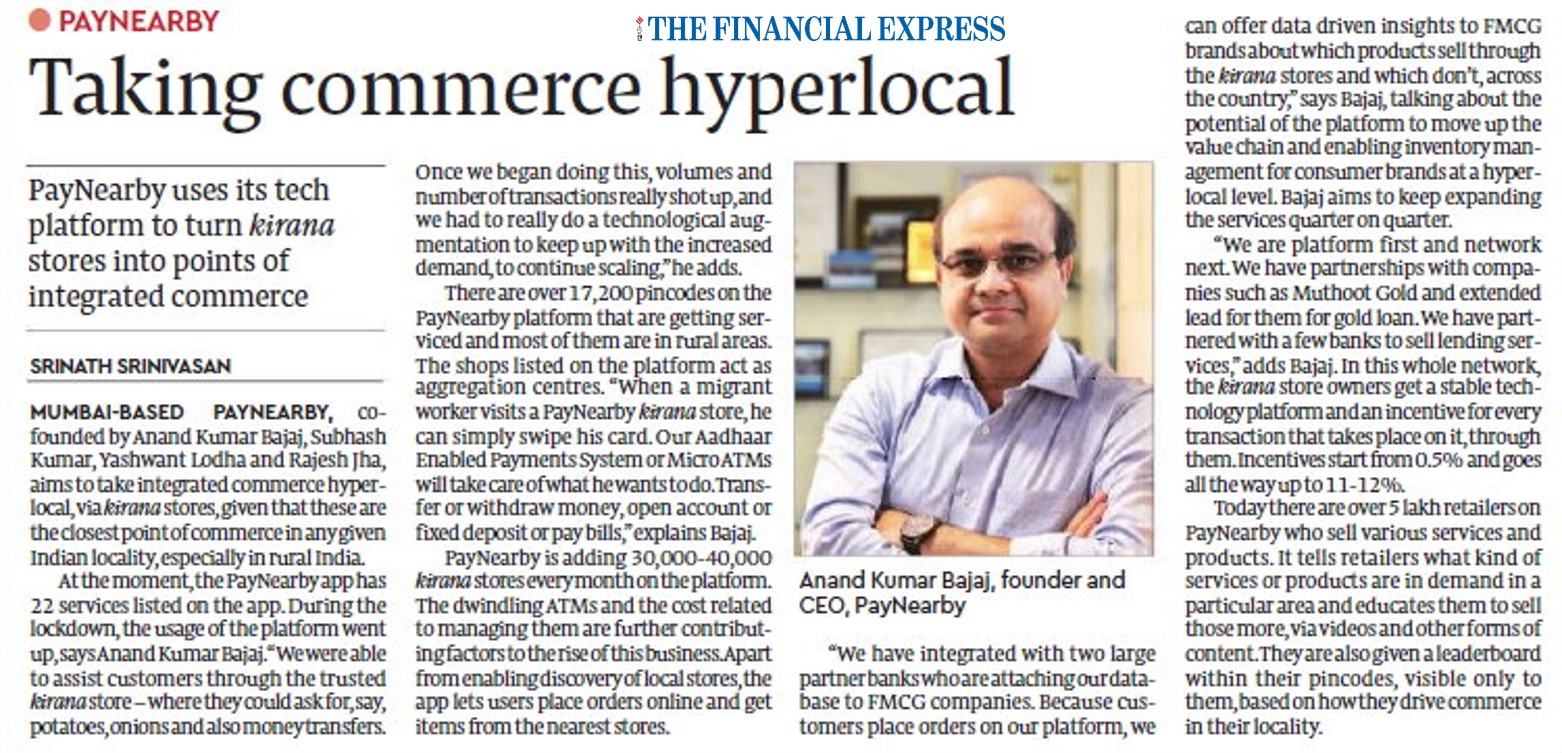
Mumbai-based PayNearby, co-founded by Anand Kumar Bajaj, Subhash Kumar, Yashwant Lodha and Rajesh Jha, aims to take integrated commerce hyperlocal, via kirana stores, given that these are the closest point of commerce in any given Indian locality, especially in rural India.

At the moment, the PayNearby app has 22 services listed on the app. During the lockdown, the usage of the platform went up, says Anand Kumar Bajaj. “We were able to assist customers through the trusted kirana store – where they could ask for, say, potatoes, onions and also money transfers. Once we began doing this, volumes and number of transactions really shot up, and we had to really do a technological augmentation to keep up with the increased demand, to continue scaling,” he adds.

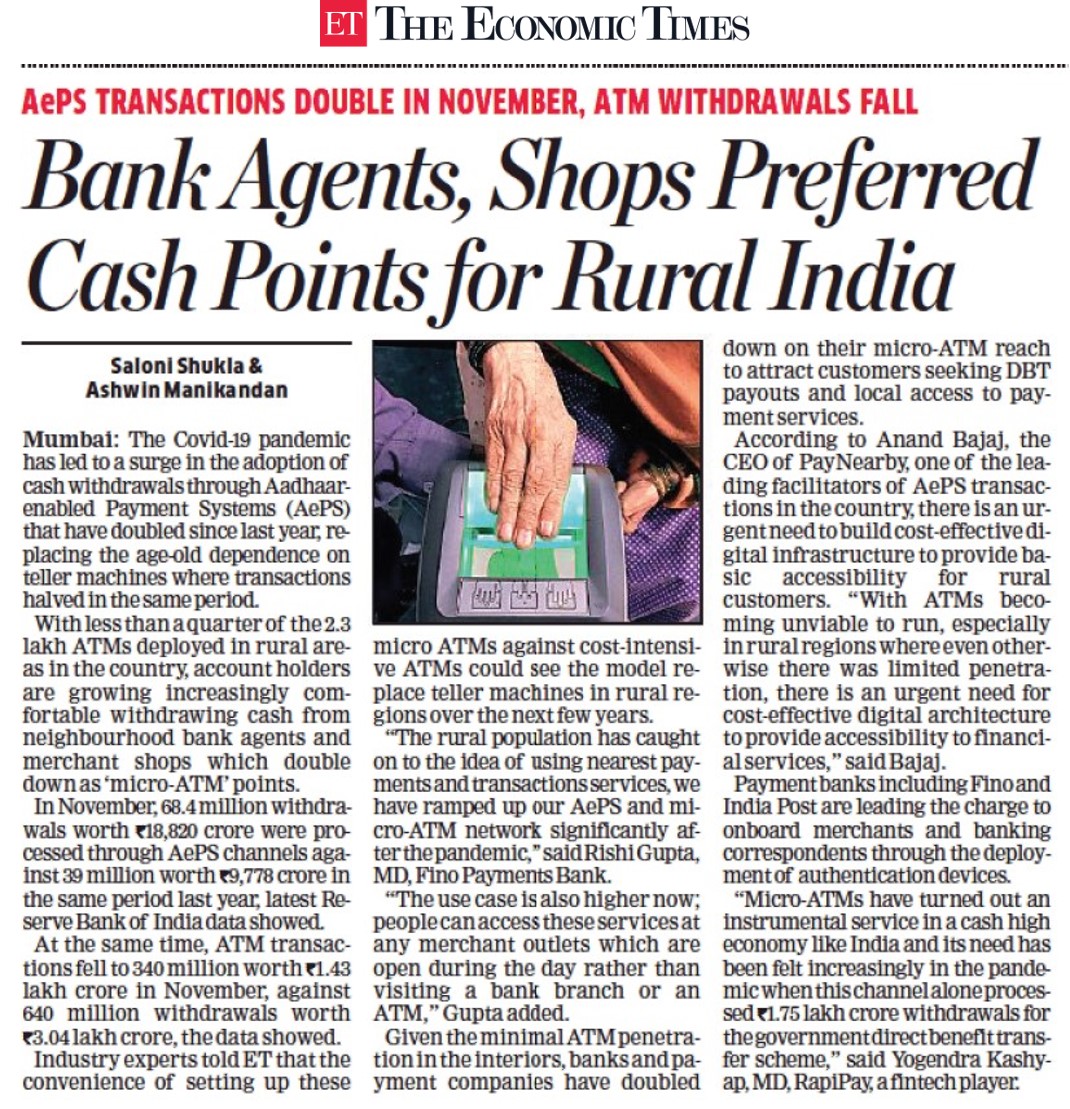
There are over 17,200 pincodes on the PayNearby platform that are getting serviced and most of them are in rural areas. The shops listed on the platform act as aggregation centres. “When a migrant worker visits a PayNearby kirana store, he can simply swipe his card. Our Aadhaar Enabled Payments System or Micro ATMs will take care of what he wants to do. Transfer or withdraw money, open account or fixed deposit or pay bills,” explains Bajaj.

PayNearby is adding 30,000-40,000 kirana stores every month on the platform. The dwindling ATMs and the cost related to managing them are further contributing factors to the rise of this business. Apart from enabling discovery of local stores, the app lets users place orders online and get items from the nearest stores.

“We have integrated with two large partner banks who are attaching our database to FMCG companies. Because customers place orders on our platform, we can offer data driven insights to FMCG brands about which products sell through the kirana stores and which don’t, across the country,” says Bajaj, talking about the potential of the platform to move up the value chain and enabling inventory management for consumer brands at a hyperlocal level. Bajaj aims to keep expanding the services quarter on quarter.

“We are platform first and network next. We have partnerships with companies such as Muthoot Gold and extended lead for them for gold loan. We have partnered with a few banks to sell lending services,” adds Bajaj. In this whole network, the kirana store owners get a stable technology platform and an incentive for every transaction that takes place on it, through them. Incentives start from 0.5% and goes all the way up to 11-12%.

Today there are over 5 lakh retailers on PayNearby who sell various services and products. It tells retailers what kind of services or products are in demand in a particular area and educates them to sell those more, via videos and other forms of content. They are also given a leaderboard within their pincodes, visible only to them, based on how they drive commerce in their locality.

PayNearby partners with TRRAIN & RAI to celebrate Retail Employees’ Day

Initiates ‘Aap Hain Toh Hum Hain’ campaign to recognise efforts of retailers

Mumbai, 12 December 2020: PayNearby, India’s largest hyperlocal fintech network with over 10+ lakh retail touchpoints, has partnered with Trust for Retailers & Retail Associates of India (TRRAIN) and Retailers Association of India (RAI), to celebrate the ‘Retail Employees’ Day’ (RED) observed on the 12th of December. The company has launched the ‘Aap Hain Toh Hum Hain’ campaign, in support of #KhulKeBoloThankYou campaign by TRRAIN & RAI, to recognise, acknowledge and applaud the efforts for every neighbourhood retailer in the country.

Retail Employees Day aims at creating awareness and empathy for the substantial role and value retailers add in the daily lives of their customers by offering convenience. And, in sync with the spirit of this day, the ‘Aap Hain Toh Hum Hain’ campaign encourages people to recognise the efforts of the local retailers across the country.

‘Aap Hain Toh Hum Hain’ is a montage of how retailers have stepped up during this pandemic and have serviced customers. They are the front-line warriors who have faced the challenges and kept their shops open so that customers could have access to the essential goods along with government relief funds and essential cash to help them tide over these turbulent times.

Whether it is essential banking facilities from their shops, or door-step delivery of DBT funds, or providing prepaid recharges that kept people connected to their loved ones, retailers have stood in solidarity for their customers. This video salutes the retailers’ selfless service in making their customers’ lives better, even in these tough times.

Mr. Anand Kumar Bajaj, Founder, MD & CEO, PayNearby said, “Retailers are the invisible force, who are building the nation ground-up. They define and shape our local communities. They are the glue that is holding the economic fabric of this country together. For India to become financially inclusive at the last mile, it is important that the local retailers, who form the majority of the retail industry, are given the necessary recognition for their contribution in this economy. PayNearby acknowledges the local retailers and is keen on improving and enriching their lives. We wish to make our retailers feel valued by building a sincere and trustworthy relationship. Our campaign expresses our heartfelt gratitude for their steadfast and relentless support. Kyunki, Aap Hain Toh Hum Hain. Happy Retail Employees Day.”

Mr. B.S. Nagesh, Founder, TRRAIN said, “If the year 2020 has taught us one thing, it is gratitude, especially towards frontline retail employees and retailers who provided us essentials in a time of need, all while risking their own health! This, 12th December, Retail Employees’ Day, we’re delighted to celebrate these heroes with our #KhulKeBoloThankYou campaign and are excited that PayNearby has joined us,  as they understand the very emotion of the retailers across the country. There could not have been a better way to thank our retailers than this unique campaign ‘Aap Hain Toh Hum Hain’ which echoes our very sentiment perfectly.”

About PayNearby:

Incepted in April 2016, Nearby Technologies is a fintech company offering financial/non-financial services to the underbanked and unbanked segment. Nearby Technologies works on a B2B2C model through its various brands – PayNearby, Insure Nearby, BuyNearby and few more. PayNearby empowers retailers at the first mile to offer digital services to local communities, thereby boosting financial inclusion in India. Retailer services are focused on Aadhaar based banking services, Domestic Remittances, Bill Payments, Card Payments, and insurance services among others.

It was founded by Anand Kumar Bajaj, Subhash Kumar, Yashwant Lodha & Rajesh Jha who bring with them rich experience in the field of banking, payments and other financial sectors. PayNearby is a DIPP-certified FinTech startup, partnering with various financial institutions including YES Bank, RBL Bank, ICICI Bank, State Bank of India, Axis Bank, CC Avenue, Bill Desk, NPCI, FASTag, NBFC and FMCG companies. It is the sole technology provider using Aadhaar Enabled Payment Services (AEPS) and IMPS to YES Bank, making them one of the only two fintech companies hosted by the National Payments Corporation of India (NCPI).

For more information, visit: https://paynearby.in/

 About Trust for Retailers and Retail Associates of India (TRRAIN)

TRRAIN is a public charitable trust formed in 2011 by B. S. Nagesh, with the vision of empowering people in retail and works to achieve immediate and lasting change in the lives of retail associates in India. They are solely committed to upgrading the lives of people in retail, both at work and at home.

TRRAIN’s initiative on building an inclusive retail workforce by creating livelihood for Persons with Disabilities in retail roles, Pankh, has received tremendous support from the industry and impacted the lives of over 17,000+ Persons with Disabilities. TRRAIN’s initiative TRRAINHer Ascent aims to create livelihood for women in retail. It has been created to train women, provide them employment opportunities in the retail industry, and help them become financially independent. TRRAIN has undertaken various initiatives to build pride and dignity through the TRRAIN Retail Awards and Retail Employees Day.

Branchless Banking: The Emerging Holy Grail

Now it is indisputable that the pandemic will have a far greater impact globally than the 2008 crisis and economies will take longer to turn around. What is certain is that essential services like the banking ecosystem need to evolve rapidly, to ensure offering uninterrupted banking services at the last mile while making seamless consumer connect a ground reality.Therefore, there is a need to propagate branchless banking through an assisted model, thereby building access to financial services as a ubiquitous phenomenon. Branchless banking is making India more financially inclusive one Pin Code at a time.

The COVID-19 crisis presents unforeseen challenges to global economies in the immediate, short, and longterm. Even as countries fight this global crisis, the response has clearly outlined the lack of resilience at the macro level. The sharp decline in global trade, liquidity crunch, difficulties in accessing credit, disrupted income streams, increase in bad debts, lowered cross-border remit-tances, and lack of access to finance, especially in developing countries like India, is reflective of the lack of a robust public infrastructure which will have long-term implications on the future eco-nomic growth.

Consumers without access to basic banking facilities have been the most affected. In the purview of future contingencies such as the Covid-19, banks and payment companies are under greater pressure to transform their operating models to expand their reach in the last mile, across both physical and digital touchpoints. Therefore, there is an imminent need for an omni-channel strategy, which is form agnostic and can serve the common citizens.

India, home to one of the most fragmented banking systems has been pushing for rationalization and rolling out new age financial start-ups to widen reach, thereby pushing the agenda of financial inclusion. However, in a vastly geo-distributedpopulationlike ours, financial inclusion has been a huge challenge owing to factors such as – socio-economic influences, inhibition to adopting tech-nology, high distribution and operational costs and lack of inclusive growth among others.

With the democratisation of financial services occupying the centre stage, offering unprecedented access is what will help revolutionise banking in India. This is where ‘branchless banking’ is pinned as the go-to model offering innovative distribution while seamlessly accelerating reach.

Today, while we have 400 million active WhatsApp users, less than 160 million avail mobile pay-ments.Thus, a majority of the population in our country, either lack the technical know-how or are inadvertently technology-shy which builds a strong case for a more personalised platform that of-fers adequate handholding besides trust and confidence that form an integral part of financial transactions.Moreover, for our country to realise the true potential of Digital India, financial inclusion should transcend beyond just a banking transaction, addressing allied offerings such as savings, lending and insurance whilst building a comprehensive service model.

Branchless banking is the new mantra of the banking industry. It is the way of offering banking services in unbanked rural areas outside of the traditional bank branches. Business correspondents (BCs) have been effectively bridging the gap between the banking institutions and the unbanked masses located in the rural areas. They act as representatives of banks and play a crucial role in promoting the financial inclusion agenda. The BC network has been an absolute win-win for the banking industry as it helps them drive an asset-light model while offering unparalleled last-mile connectivity including the tier-II, III markets and the hinterlands.

Gone are the days when countryside citizens travelled hours to visit a bank just to check their balance. Banking Correspondents have come as a boon to the rural masses by helping them enjoy banking services without going through the hassle of travelling. Even during the lockdown, the government’s direct benefit transfer of 1.7 lakh crore to the poorest sections, worst hit by the pandemic was largely realised by banking correspondents who ensured that the most margina-lised communities could easily access the relief funds.

Furthermore, banks must understand the enormous unrecognised potential of the rural cohorts. Taking cognizance of the existing financial strain, it is imperative to realign our focus as ‘rural consumption’ is all set to play a catalytic role in the growth of the overall economy. Considering the strength of the BC establishment, especially in rural India, the latter is well poised to play a very significant role in this growth story.

With microfinance being an integral part of the rural economy, sachetising financial services like lending and insurance through branchless banking and the BCs’ actively serving as agents of change can encourage and equip the rural cohort with the means to meet their financial goals.Financial offerings are inherently based on trust and who better than the local kiranawala, who enjoys both a personable relationship and an affinity for their needs. Besides financial inclu-sion, this will also help boost consumption and spending among the masses, eventually offering huge impetus to the economy.

Gradually, even non-banking financial services are also joining the bandwagon, especially with the launch of e-KYC. Regulators like RBI and SEBI are continuing to encourage the move towards branchless transactions through pushing the technology acceptance model.

Now it is indisputable that the pandemic will have a far greater impact globally than the 2008 crisis and economies will take longer to turn around. What is certain is that essential services like the banking ecosystem need to evolve rapidly, to ensure offering uninterrupted banking services at the last mile while making seamless consumer connect a ground reality. Therefore, there is a need to propagate branchless banking through an assisted model, thereby building access to financial services as a ubiquitous phenomenon. Branchless banking is making India more financially inclusive one Pin Code at a time.

PayNearby partners with NPCI to launch PayNearby Shopping Card powered by RuPay for retailers

Catalyst to digitize cash for mass market customers to enable them to enjoy benefits of digital commerce

Mumbai, December 3rd: PayNearby, India’s largest hyperlocal fintech startup, has partnered with YES Bank and National Payments Corporation of India (NPCI) to launch PayNearby Shopping Card, enabling its retail partners to derive maximum benefits of digital commerce in the mass market category. The new offering aims to enable PayNearby retailers to seamlessly consume a range of digital services, like ecommerce, e-learning, online gaming, online music and videos, monthly recharges and utility payments in a secure, risk free mode.

India has a large underbanked, un-carded, digitally shy population who still transact in cash. Mass market penetration of digital services in India is challenged because of the limited adoption of digital money.  The launch of PayNearby Shopping Card powered by RuPay is aimed to enable mass market adoption, so that cash digitization options are available at grass root levels.

The PayNearby Shopping Card will offer our retailers a safe and simple payment instrument to fulfil their digital commerce requirements. The card is easy to use and is enabled across 10 lakh plus PayNearby retail touch points, across 17,000 plus PIN codes in the country.  The retailers can avail the card by completing the KYC. The maximum wallet balance at any point in time can be Rs. 1 Lakh and users can transact upto Rs. 5 lakh monthly and Rs. 25 lakhs annually.

PayNearby is committed to uplifting the technology shy population and taking them up the digital curve so that benefits of digital advancements can be more widespread. Active usage of these cards will be promoted through tailored campaign for both retailers and consumers. The new offering aims to boost online transactions across platform in ecommerce purchase, monthly utility payments, mobile recharges, online education subscriptions and more. In post COVID era, when contactless payments and digital commerce have become so significant to avail services, PayNearby aims to enable masses to access these benefits through PayNearby Shopping Card powered by RuPay.

The prepaid card is a secured payment instrument and mitigates the risk of cyber fraud, especially in case of high-volume transactions. While it operates very similar to a debit card, unlike the latter, the PayNearby Shopping Card is linked to a PayNearby wallet rather than a bank account. Users can load as much or as little money as they are comfortable with, thus minimizing risks while securing payments. Fraud protection mechanisms put in place ensure transactions are secure and there is no data compromise.

One of the most salient features of the offering is that it enables the user to seamlessly lock/unlock the card digitally while also offering a summary of the transaction statement which in turn helps users to keep their spending under check.

Commenting on the announcement, Anand Kumar Bajaj, Founder, MD & CEO, PayNearby stated, “We are delighted to partner with NPCI to launch the PayNearby Shopping Card powered by RuPay, a virtual prepaid instrument that ensures secure transactions. Our Digital Pradhan network has been at the forefront of the pandemic, serving as corona warriors and providing seamless banking at the grassroots level. We have been processing over Rs. 100 crore transactions daily since the lockdown, and handling large volumes.

The launch of PayNearby Shopping Card powered by RuPay will act as a catalyst in our cash digitization efforts and help us uplift local communities by enabling access to a lot of digital services, which were earlier limited to 10% of India’s population who had access to digital money. It is our duty to ensure that our retailers and our customers get the maximum benefit of digital advancements in these challenging times, while assuaging any concerns of misuse and cyber frauds.

PayNearby retailers offer a host of non-financial services such as travel ticket booking, utility bill payment and mobile recharges among others to the local population which requires digital mode of payments. Additionally, where cash on delivery (COD) is not available it becomes a challenge for a customer to avail ecommerce and other services as they are required to pay digitally in advance. These customers are unbanked and underbanked and do not have access to digital payment instruments. The virtual prepaid card can play the role of an enabler offering access to assisted agent banking as the retailer can seamlessly pay for the customer using the PayNearby Shopping Card.”

Praveena Rai, COO, NPCI said, “We are pleased to partner with PayNearby and launch the PayNearby Shopping Card. Through this strategic partnership, we endeavor to deepen the financial inclusivity in the country and empower the underbanked population with seamless digital payments facility for their day to day transactions. This initiative enables small scale local retailers to upgrade and add value to their businesses with digital commerce facility, this will also act as a driving force for local retailers to onboard into the digital payment ecosystem. We believe this collaboration is a step ahead towards realizing our vision of digital payments for all.”


About PayNearby:

Incepted in April 2016, Nearby Technologies is a fintech company offering financial/non-financial services to the underbanked and unbanked segment. Nearby Technologies works on a B2B2C model through its various brands – PayNearby, Insure Nearby, BuyNearby and few more. PayNearby empowers retailers at the first mile to offer digital services to local communities, thereby boosting financial inclusion in India. Retailer services are focused on Aadhaar based banking services, Domestic Remittances, Bill Payments, Card Payments, and insurance services among others.

It was founded by Anand Kumar Bajaj, Subhash Kumar, Yashwant Lodha & Rajesh Jha who bring with them rich experience in the field of banking, payments and other financial sectors. PayNearby is a DIPP-certified FinTech startup, partnering with various financial institutions including YES Bank, RBL Bank, ICICI Bank, State Bank of India, Axis Bank, CC Avenue, Bill Desk, NPCI, FASTag, NBFC and FMCG companies. It is the sole technology provider using Aadhaar Enabled Payment Services (AEPS) and IMPS to YES Bank, making them one of the only two fintech companies hosted by the National Payments Corporation of India (NCPI).

For more information, visit: https://paynearby.in/

About RuPay:

RuPay, first-of-its-kind India’s indigenous Debit and Credit payment network, was launched by National Payments Corporation of India (NPCI). It has been designed to address the evolving needs of Indian consumers, merchants and banks.

About NPCI:

National Payments Corporation of India (NPCI) was incorporated in 2008 as an umbrella organization for operating retail payments and settlement systems in India. NPCI has created a robust payment and settlement infrastructure in the country. It has changed the way payments are made in India through a bouquet of retail payment products such as RuPay card, Immediate Payment Service (IMPS), Unified Payments Interface (UPI), Bharat Interface for Money (BHIM), BHIM Aadhaar, National Electronic Toll Collection (NETC Fastag) and Bharat BillPay. NPCI also launched UPI 2.0 to offer a more secure and comprehensive services to consumers and merchants.

NPCI is focused on bringing innovations in the retail payment systems through use of technology and is relentlessly working to transform India into a digital economy. It is facilitating secure payments solutions with nationwide accessibility at minimal cost in furtherance of India’s aspiration to be a fully digital society.

For more information, visit: https://www.npci.org.in/

Interview with Anand Kumar Bajaj, Founder, MD & CEO at PayNearby

Over the years, FinTech has turned into a lucrative and innovative sector with a rising number of emerging technologies contributing to a complete shift in the financial services industry as a whole; in this interview – Anand Kumar Bajaj, MD & CEO at PayNearby discusses these changing trends while talking about fintech’s impact in Asia.

Can you tell us a little about yourself Anand? Given your time in finance/fintech – we’d love to hear about your thoughts and observations on how you are seeing this segment shape up (within the Asia-Pacific region and globally).

 Growing up in a small town in Bihar, several instances made me realize how many regional areas have limited access to banking facilities or have to travel long distances for financial transactions. Those childhood experiences solidified my belief to give back to the country, and I committed myself to the vision of nation-building. Being an IIM – A alma mater and post completing my Chartered Accountancy, I began my professional journey at ICICI Bank, where, under the mentorship and guidance of Ms. Madhabi Puri Buch and Mr. Ajay Gupta, we converted my work into 5 patents. After 10 years of work at ICICI, I joined YES Bank as the Chief Innovation Officer, where I had the opportunity to work on several high-impact projects surrounding digital payments. Before leaving the bank, we built a large remittance platform for migrants and the under privileged people and subsequently created a large program for Freecharge, which became the world’s largest prepaid card program in 6 months’ time. My time at these banks imparted in me that innovation comes from collaboration, and with this intent, a few friends from the industry came together to form Nearby Technologies in 2016.

There is a lot of potential in Asia as a market for the growth of fintech. Currently, there are 62.5 ATMs per 100,000 people in Europe, but only 12.5 per 100,000 people in the APAC region, making mobile-based financial services and products extremely attractive in these countries.  Fintech startups, with their adaptive, low-asset investment model are a feasible option for countries with larger populations to adopt. Fintech businesses are particularly adept at reaching “tech-literate yet financially underserved” market, and by leveraging the established banking sector, can drastically catalyse the advancement of neo-banking in these regions.

How did the idea for PayNearby come about initially and could you tell us about some key highlights from your journey so far with the startup?                                                                 

PayNearby, is the flagship brand of Nearby Technologies and was set up with a vision to bring basic banking facilities in the inroads of the country, where the real Bharat resides. Fintech innovation focused on meeting the needs of the urban 10%, thus largely ignorant of the plight of rural dwellers and how they were marginalised in the financial inclusion process.

With only 3% of insurance penetration in India, only 8% have invested in mutual funds, only 22% have access to finance, we needed to sachetise existing banking services in a way that it would be accessible to people nearby, while also handholding a technology shy population to the next stage of development. The traditional kiranas always formed the heart of every community and owned inexplicable understanding for their needs. We realized collaborating with these brick and mortar stores would enable us make inroads into the pulse of the population, and leverage the unique relationship nurtured by these stores.

With this concept in mind, we formed Nearby Technologies in 2016 to uplift retailers and stand up to the challenge of propagating financial inclusion through creation of the world’s largest assisted hyperlocal agent banking platform and network. The company’s mission to make ‘Har Dukaan Digital Pradhan’ is envisaged to empower the local retailer and create a thriving eco-system for the local community. PayNearby has successfully enabled Digital Pradhans to provide many essential services to their local communities, including Aadhaar banking, bank deposits, insurance, access to government schemes and many more.

Today, PayNearby is India’s largest hyperlocal fintech network, and the largest agent banking platform in entire Southeast Asia. We service close to 10 crore Indians on a range of products and services, conducting a monthly throughput of ~4500 crore and clocking 10 lakh plus transactions on a daily basis, PayNearby is leading the segment with Aadhaar enabled Payment System (AePS), or Aadhaar banking with 33% market share.  Our team of Digital Pradhans have worked tirelessly to seamlessly facilitate cash withdrawal and transfer – conducting over 7-8 lakh transactions per day during the nation-wide Covid-19 lockdown. This has been enabling the hardest hit especially the migrants and the rural population to access the Government’s DBT (Direct Benefit Transfer) disbursements with ease. Our company has enabled financial inclusion worth INR 775 crores to the consumers in 115 backward aspirational districts, identified by NITI AAYOG.

 How do you see emerging tech play a key role in how newer fintech innovations are built/developed?

FinTech has evolved as one of the most innovative and cost-effective sectors. A number of emerging technologies have reshaped the financial services industry through innovation while catering to evolving customer expectations offering personalisation and convenience. Brands are now actively moving towards hyper personalisation to speak to the consumer and build brand recall. Emerging technologies are imbibing artificial intelligence and machine learning on a large scale, which is transforming day to day business.

Banks and fintechs that handle large amounts of big data are increasingly moving to cloud-based platforms and blockchain to universalise access to information. With the growth of technology and ever-changing demands of financial markets, the changes are inevitable. Each year transforms fintech in a new way. Artificial Intelligence, Internet of Things, Machine Learning with blockchain and conversational banking will all play a crucial role in attracting customers and increasing the efficiency of the financial institutions going forward.

We’d love to know how PayNearby is enabling better payments. What are your thoughts when it comes to the future of payment platforms and lending apps – what are some of the ways this space will change/what are the in-demand features that will drive growth here?

At PayNearby, we understand that trust and seamless continuity are the crux of finance, and are constantly evolving to meet the needs of our consumers to give them the best, most hassle-free experience. Our agile and judicious use of technology has allowed us to grow our business in a short amount of time; with our PAN India network spreading over 17,200 PIN codes in less than four years. Currently, the company is well positioned to meet its aggressive goals to ramp up and extend assisted hyperlocal services in the county – and upgrade its network from 8,50,000 retailers to 50,00,000 retailers in the near future.

During the lockdown, our network not only facilitated DBT in rural areas, but our banking correspondents ensured that transactions continued undisrupted even in afflicted urban areas and medical stores through our AePS platform. We have also recently expanded our hyper local discovery and purchase application ‘BuyNearby’ for PAN India operations with IndusInd Bank as digital payment partner. BuyNearby, is an e-commerce platform for kirana stores which lets consumers identify the nearest local stores around them and order online. In the wake of the lockdown, which has mandated restricted movement, providing essentials is crucial, and that is what we have always strived to do – make lives easier. The current scenario is definitely challenging, and has served as a learning curve for most businesses. Technology has been the cornerstone and foundation of innovation for most sectors and we at PayNearby aim to bring the top-end technologies to the bottom of the pyramid.

Going forward, collaboration between banks and fintech is the key to future growth future. Merging the legacy of traditional financial institutions and the agility of fintechs will maximise operational efficiency while exploring new growth avenues. Open banking too, a fairly nascent concept yet, will hit its stride post-Covid-19. The pandemic has brought about drastic behavioural shifts in terms of how we transact and consume, which will lay further emphasis on everything digital.

Can you also share your thoughts on other (global) finance technologies in the marketplace that are game changers when it comes to payments facilities?

The payment industry has seen significant adoption and innovation and is in an exponential growth trajectory. Globally many countries are keeping a close watch on the payment technology and looking to implement similar payments features.

 Given the current world situation, what would your top tips be to B2B/Global tech/Fintech (product) companies to secure their transactions and prevent fraud during this time, given how a rise in cybercrime cases have been a recent cause of concern because of increase in digital banking and related security threats due to Covid19.

Integration of technology is growing and transforming every aspect of businesses globally, bringing out solutions that simplify and solve existing problems. With the ongoing pandemic, huge data migration has taken place from one system to another, and many have shifted data to cloud based storage solutions. The basics of security and implementing latest solutions to protect our systems and data is a must due to the large risks associated with such activities. Organizations must take proactive steps by advising and training their staff and customers to be more vigilant and cautious especially when opening links, emails or documents related to the subject COVID-19. B2B and fintech companies handling sensitive information like financial transactions need to adjust their threat detection mechanisms and response approaches to address new threats to networks and endpoints, as the shift to remote working has created a new set of challenges.

What are some of your thoughts on how the current world situation (the Covid19 situation) will impact the use of (and development) of the fintech segment?

The current pandemic is likely to drive deeper relationships between incumbent banks and startups for a more digitally empowered future. With the world’s largest and the most stringent lockdown in action, home quarantining more than 1.3 billion has interestingly brought surge in ‘digital’, including – withdrawal of money, digital payments, OTT, online gaming, e-commerce and e-education among others. Many from rural India who never used digital platforms in their life time used AePS to withdraw money from their account. It is an optimal time to leverage this period, and push phygital as a fintech model which is sure to go a long way for a country like India with its fragmented population.

‘Social distancing’ being the new norm, may serve to be the latest accelerator for digitisation. With demand for digital financial services on the rise, many fintech businesses are now planning to aggressively grow their customer base besides exploring new product offerings and growth avenues. Fintech as an industry has been a force of innovation during this time. The industry is now better geared towards collaboration – using innovative tools and technologies in creating lasting partnerships with others in the sector. Going forward too, fintechs will now be able to serve customers that are usually excluded by the traditional banks due to lack of collateral or other factors.

Tag (mention/write about) the one person in the (global/international) fintech industry whose answers to these questions you would love to read!

Bret King, CEO of Moven, a New York-based mobile banking startup and Cris Skinner, an influential, independent commentator on financial markets,

 Your favorite FinanceTech  quote

Bringing Hi-Tech to the Bottom of the Pyramid for the customers.

Would you like to share specific finance or business tips for Marketing and Sales teams struggling through this uncertain time?

Repurposing and re-skilling are the need of the hour. It is important to remain sensitive to consumer needs and keep up with their evolving psyche. With more people staying in, and browsing websites, it would be prudent to refocus marketing tactics on online platforms to increase brand visibility and recall.


Fintech companies eye Kirana stores; launch services to digitise the system

Fintech apps are jumping at the opportunity, considering that there are about 1.2 crore kirana stores

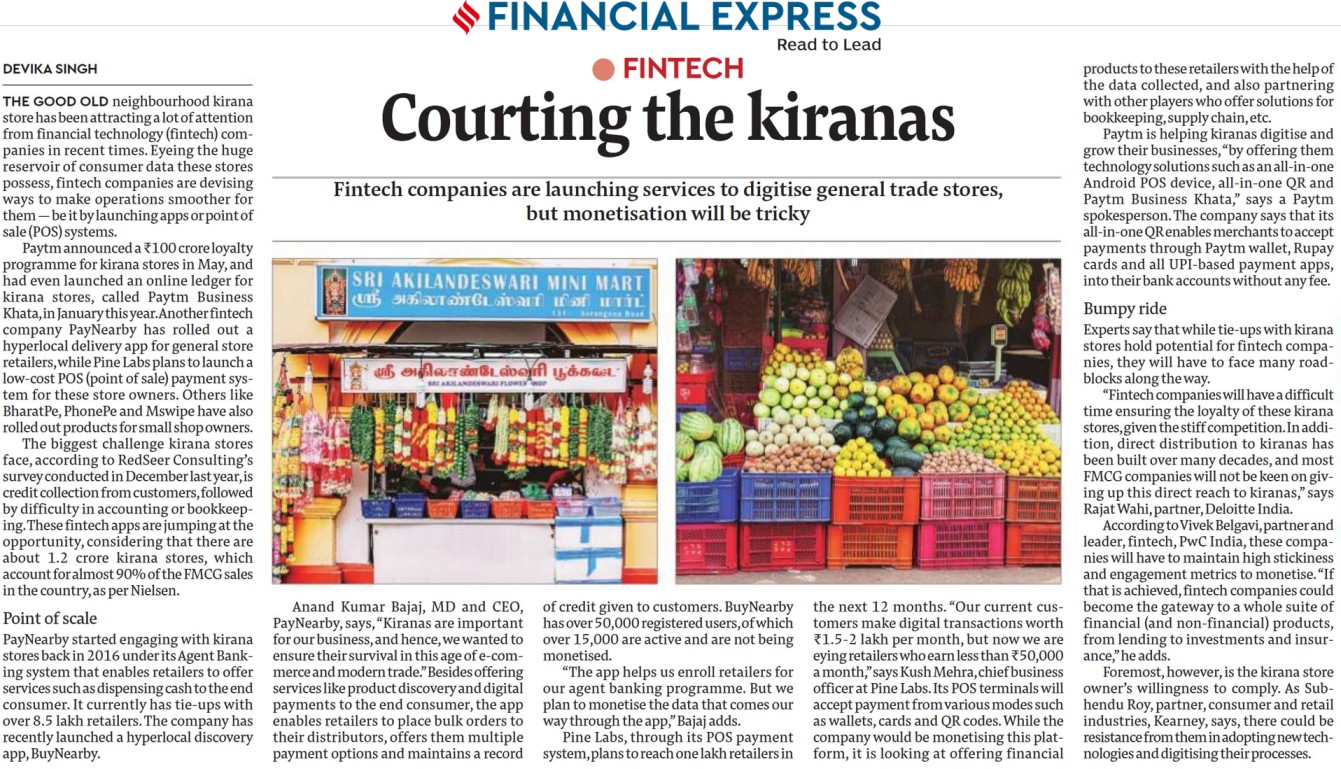
The good old neighbourhood kirana store has been attracting a lot of attention from financial technology (fintech) companies in recent times. Eyeing the huge reservoir of consumer data these stores possess, fintech companies are devising ways to make operations smoother for them — be it by launching apps or point of sale (POS) systems.

Paytm announced a Rs 100 crore loyalty programme for kirana stores in May, and had even launched an online ledger for kirana stores, called Paytm Business Khata, in January this year. Another fintech company PayNearby has rolled out a hyperlocal delivery app for general store retailers, while Pine Labs plans to launch a low-cost POS (point of sale) payment system for these store owners. Others like BharatPe, PhonePe and Mswipe have also rolled out products for small shop owners.

The biggest challenge kirana stores face, according to RedSeer Consulting’s survey conducted in December last year, is credit collection from customers, followed by difficulty in accounting or bookkeeping. These fintech apps are jumping at the opportunity, considering that there are about 1.2 crore kirana stores, which account for almost 90% of the FMCG sales in the country, as per Nielsen.

Point of scale

PayNearby started engaging with kirana stores back in 2016 under its Agent Banking system that enables retailers to offer services such as dispensing cash to the end consumer. It currently has tie-ups with over 8.5 lakh retailers. The company has recently launched a hyperlocal discovery app, BuyNearby.

Anand Kumar Bajaj, MD and CEO, PayNearby, says, “Kiranas are important for our business, and hence, we wanted to ensure their survival in this age of e-commerce and modern trade.” Besides offering services like product discovery and digital payments to the end consumer, the app enables retailers to place bulk orders to their distributors, offers them multiple payment options and maintains a record of credit given to customers. BuyNearby has over 50,000 registered users, of which over 15,000 are active and are not being monetised.

“The app helps us enroll retailers for our agent banking programme. But we plan to monetise the data that comes our way through the app,” Bajaj adds.

Pine Labs, through its POS payment system, plans to reach one lakh retailers in the next 12 months. “Our current customers make digital transactions worth Rs 1.5-2 lakh per month, but now we are eying retailers who earn less than Rs 50,000 a month,” says Kush Mehra, chief business officer at Pine Labs. Its POS terminals will accept payment from various modes such as wallets, cards and QR codes. While the company would be monetising this platform, it is looking at offering financial products to these retailers with the help of the data collected, and also partnering with other players who offer solutions for bookkeeping, supply chain, etc.

Paytm is helping kiranas digitise and grow their businesses, “by offering them technology solutions such as an all-in-one Android POS device, all-in-one QR and Paytm Business Khata,” says a Paytm spokesperson. The company says that its all-in-one QR enables merchants to accept payments through Paytm wallet, Rupay cards and all UPI-based payment apps, into their bank accounts without any fee.

Bumpy ride

Experts say that while tie-ups with kirana stores hold potential for fintech companies, they will have to face many roadblocks along the way.

“Fintech companies will have a difficult time ensuring the loyalty of these kirana stores, given the stiff competition. In addition, direct distribution to kiranas has been built over many decades, and most FMCG companies will not be keen on giving up this direct reach to kiranas,” says Rajat Wahi, partner, Deloitte India.

According to Vivek Belgavi, partner and leader, fintech, PwC India, these companies will have to maintain high stickiness and engagement metrics to monetise. “If that is achieved, fintech companies could become the gateway to a whole suite of financial (and non-financial) products, from lending to investments and insurance,” he adds.

Foremost, however, is the kirana store owner’s willingness to comply. As Subhendu Roy, partner, consumer and retail industries, Kearney, says, there could be resistance from them in adopting new technologies and digitising their processes.

Our Partners

Download PayNearby now

Use PayNearby app & take charge of all your transactions to grow your business