Alternate means of cash withdrawals find favour as people shun ATMs

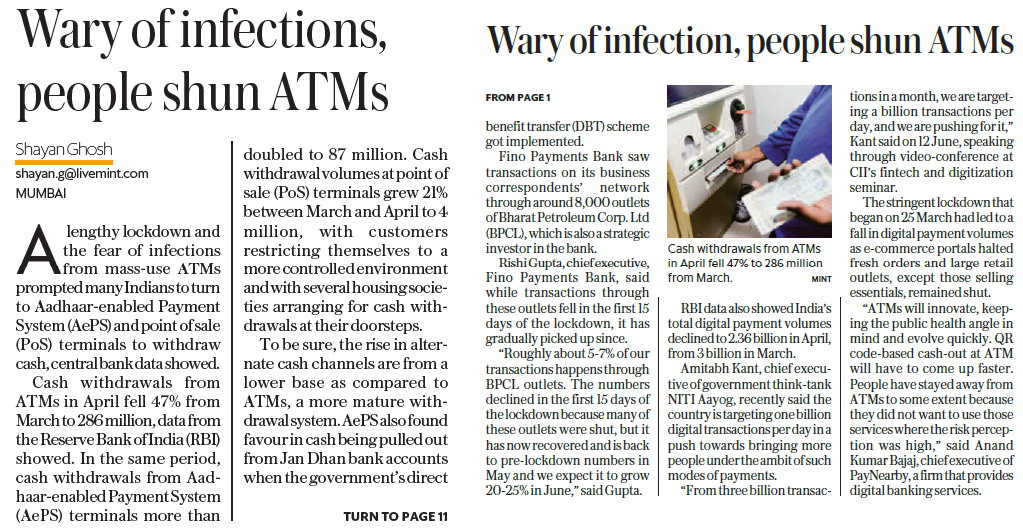
  • Data from Reserve Bank of India (RBI) showed that cash withdrawals automated teller machines (ATMs) declined by 47% to 286 million in April

MUMBAI: Alternate channels of cash withdrawals like Aadhaar-enabled Payment System (AePS) and point of sale (PoS) terminals grew faster during the lockdown than traditional ATMs, latest RBI data showed.

Data from Reserve Bank of India (RBI) showed that cash withdrawals automated teller machines (ATMs) declined by 47% to 286 million in April. At the same time withdrawals from AePS more than doubled to 87 million. That apart, cash withdrawal volumes at PoS terminals grew 21% between March and April to 4 million as customers wary of the spread of covid-19, from using a public ATM, restricted themselves to a more controlled environment as housing societies arranged for cash withdrawals at doorstep.

To be sure, the rise in alternate cash channels are from a lower base as compared to ATMs, a more mature withdrawal system. AePS also found favour in cash being pulled out from Jan Dhan bank accounts when the government’s direct benefit transfer (DBT).

Fino Payments Bank has seen transactions on their business correspondent network through around 8,000 outlets of Bharat Petroleum Corporation Ltd (BPCL), which is also a strategic investor in the bank.

According to Rishi Gupta, chief executive, Fino Payments Bank, while transactions through these outlets declined in the first 15 days of the lockdown, it has gradually picked up ever since.

“Roughly about 5-7% of our transactions happens through BPCL outlets. The numbers declined in the first 15 days of the lockdown because many of these outlets were shut but it has now recovered and is back to pre-lockdown numbers in May and we expect it to grow about 20-25% in June,” said Gupta.

The RBI data also showed that India’s total digital payment volumes declined to 2.36 billion in April, from 3 billion in March. Amitabh Kant, chief executive of government think-tank Niti Aayog recently said that India is targeting one billion digital transactions per day in a push towards bringing more people under the ambit of such modes of payments.

“From three billion transactions in a month we are targeting a billion transactions per day and we are pushing for it,” Kant said on 12 June, speaking through video-conference at CII’s fintech and digitisation seminar.

The covid-19 lockdown that began on 25 March had led to a fall in digital payment volumes as e-commerce portals stopped taking orders and customer spending at large retail outlets dropped.

“I believe ATMs will innovate, keeping the public health angle in mind and evolve quickly. QR code-based cash-out at ATM, will have to come up faster. People have stayed away from ATMs to some extent because they did not want to use those services where the risk perception was high,” said Anand Kumar Bajaj, chief executive of PayNearby.

Bajaj added that there was sudden clamp on trade and consumption during the lockdown and people were spending mainly on essentials and groceries during that period.

“Therefore, people’s need to go to ATMs for cash declined,” he said.

Meanwhile, RBI has now started providing daily data on select payment systems. It showed that ATM cash withdrawals averaged at 10.2 million on a daily basis between 1-14 June.

According to Navroze Dastur, managing director, NCR India, April was the primetime of the lockdown and movements were significantly restricted.

“We saw a drop of about 60% in ATM transactions because people were not going out to withdraw cash. In May and June, ATM transactions have again started picking up, while it has not reached the pre-pandemic levels,” said Dastur.

The Communicators’ Assembly Point – 2: Communications in start-ups

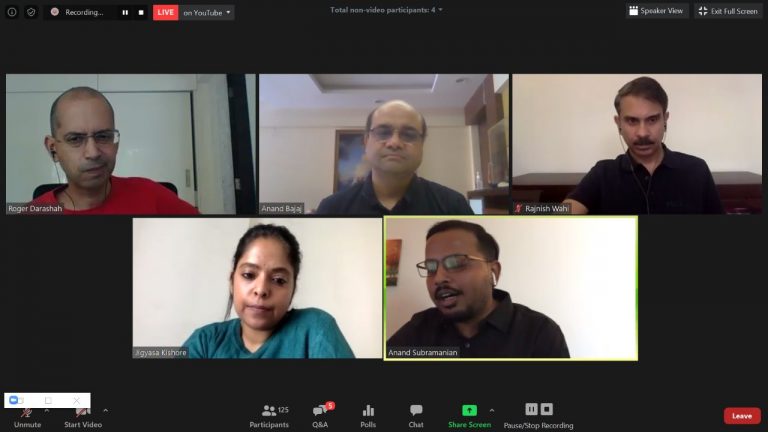
Marketers and brands will have to navigate reputation in the post-COVID era. Life took a downturn for all of us when the lockout was declared on March 24. Navigating COVID-19 is indeed a test of reality and reputation. We will all have to navigate a world that will never be the same again. We got some interesting insights from Indian start-ups as Roger Darashah, Chief Operating Officer, Adfactors PR moderated the discussion of The Communicators Assembly: Point 2.

If we wondered whether the coronavirus pandemic will be world-changing, how did life actually change on March 24, when the lockdown was formally declared? It remained as transparent and frequent as always, but what changed was the timing pointed out Anand Bajaj, Founder & CEO, PayNearby and added “it was a force multiplier for us”. It played out in two parts for Rajnish Wahi, Senior Vice President – Corporate Affairs and Communication, Snapdeal – first it was to inform and reassure and after lockdown the communication became ‘here and now’. Nobody knew what was going on, according to Jigyasa Kishore, Global Director, Moglix but the carpe diem had meaning for everyone – how we are going to operate as an organisation and never before has communication become more important.

Sprucing up communication

It was subjective and ambiguous alright, but did the start-ups have any policies in line to take stalk of the situation? Immediately starting off communication was Ola as explained by Anand Subramanian, Head of Communications, Ola as within hours, they put forward a plan to get drivers together. The key word was collaboration, and in a matter of hours, went on to support the government with their operational strength, having launched medical trips etc. Interestingly, we were able to quickly adapt guidelines for customers and also strictly kept to the guidelines of the government and working towards the need of the hour, said Jigyasa as she also admitted that “there was some craziness, but it has died out and now there is stability”.

Communication is key during such crisis. Financial services was not included in “essential services” initially but it was included soon – as money had to reach the hands of people to buy medicines, groceries etc. PayNearby had the communication advantage when Leo Burnett launched the campaign – Zid aage badne ki, which went well with their 4 lakh touchpoints. With improved communication, for Snapdeal there was a permanent shift for the good. The “human touch” came back rapidly, as Rajnish put it. Snapdeal launched the essentials category in a matter of three days, which would have normally taken six months!

With communication plans, we essentially have budgets allocated. Bajaj insisted they are a start-up and there was no budget. However, the work multiplied with zero budget. Big budget went down to zero, shared Rajnish – a view shared by both Subramanian and Jigyasa.

A start-up advantage?

Cutting-edge disruptors foster startup-driven innovation and start-ups definitely cut a different picture. Roger attempted to check out – does the ‘start-up mentality’ really provide an advantage or is it a disadvantage? Do you think start-up mentality makes communicators more agile during these times?

It is an advantage, said Bajaj and with limited capital, we can do more – coming to the storytelling and we can command more impact, and today it’s an open, hungry market. The fruit of COVID was that Ola started three large initiatives that were timely and necessary – Drive the Driver Fund (a true blue COVID initiative), Ola Emergency (which transformed into a service with a high standard of safety) and Ola Connect, which will stay for a while; social distancing and work-from-home (WFH) not going anywhere. For Moglix, the initiatives were for internal and external stakeholders; they were covering ground fast for the UK launch and for internal stakeholders started an initiative called – Training Pathshala.

Creativity of messaging

The PR universe is creative and involved in innovative ways to communicate and get into brand storytelling with passion. But with COVID jostling up this level of intensity, how did one find the mental space to make quick decisions, wondered Roger.

Campaigns flashed messages, saying it all. As did the Ola “Stronger together” campaign and then empathy doled out internally to the drivers and employees had a big role to play in the creative space, shared Subramanian. “Our work is our communication. We made sure our transactions did not fail through better technological infrastructure”, disclosed Bajaj.

Managing stress & media selection

When everything around you comes to a standstill, how do you manage to keep some balance? Focusing on the positive news to help others, creating mental awareness and giving out WFH tips said Jigyasa. Going into messaging for which they want to be remembered five years down the line, was Snapdeal and Rajnish exclaimed it was a great time to build relations with media as crisis brought out the best and it was “immensely gratifying”.

Our work was our communication, said Bajaj. And, there has been a tremendous uptake on the impact of social media in the last few months, which he highlighted. Looking at this, media had become most impactful during this COVID crisis, Rajnish noted that there was this obsession to get into the print media before, but today digital has become the new mantra; and people realised that e-commerce has been a really reliable channel to get what they want. The trust has increased, digital remains big and so does broadcast, felt Subramanian who added that they also continued to use their own media (the Ola app).

The new “normal”

What about rebuilding trust around e-commerce? The way contact and delivery happened has changed dramatically with the “touch” factor. All this is not just to ensure trust, but what is the alternative, questioned Jigyasa. Hygiene has become the new normal, and on the other hand, trust has increased and has not eroded observed Rajnish.

With economy taking a hit, the possibility of layoffs and cost-cutting has indeed, been discussed a lot. In such difficult circumstances, one must “lead by example” and since business and people are going to be affected, it’s important to be compassionate felt Subramanian. Echoing his opinion, Rajnish insisted if layoffs happen, employees should not feel it’s a personal condemnation but they should see it as situational.

And, how should communication try to be involved in the process? Transparency and preparedness helps when communicating necessary business news, shared Jigyasa. To repurpose things have become a way of life now, said Bajaj.

Has the COVID pandemic impacted relationships with founders? This point was brought up by Madan Bahal, Co-Founder and Managing Director of Adfactors PR. It has fostered a deep understanding, said Subramanian while Rajnish felt crisis moments takes you closer, since you have been through the rough and tumble, plus it brings in more confidence and prepares you to work better. And, as equity partnerships went, Bajaj elaborated that the investor has been fantastic, understanding and that “it is a blessing to have an investor who is hands-free and trusting”.

What can PR firms do more than just generate coverage? How can the relationship between PR consultants and start-ups change post-COVID? “We never expected coverage. The real value is strategy,” remarked Rajnish. He mentioned that they chose to be very concise with their communication during the lockdown.

Lastly, what will be the one thing that will change permanently due to COVID in the way that we communicate, was a very valid question raised by Roger.

More precise and faster communications, more empathy, faster speed – will be the defining features said Rajnish. It’s empathy and knowing that we are in it together that helps bring in tremendous amount of creativity, and it should be impact-driven shared Subramanian while Bajaj said it was “the instant response expectation”.

Signing off was Jigyasa as she said, “It is going to be related to COVID for a very long time”.

How PayNearby is empowering kirana stores to fight Covid-19

Share a brief about the business you are in and the market that you have seen in the last 4 years?

PayNearby is the flagship brand of Nearby Technologies that operates on a B2B2C business model. Ours is an assisted hyperlocal fintech network that was set up to provide the last mile access of basic financial services to the unbanked and the under-banked. We empower retailers at the first mile to offer digital services to local communities, thereby boosting financial inclusion in India.

With more than 8,50,000 retailers comprising approximately 17,200 PIN codes across India, PayNearby today owns the country’s largest hyperlocal fintech network and services close to 10 crore Indians on a range of products and services. With a monthly throughput of ~4500 crores and clocking 10 lakh plus transactions on a daily basis, PayNearby today stands tall as the largest agent banking platform in the entire Southeast Asia region.

PayNearby is leading the segment with Aadhaar enabled Payment System (AePS), or Aadhaar banking with a 33% market share, which facilitates cash withdrawal, and balance inquiry through customer’s Aadhaar number and fingerprint authentication. Applying the mantra of “Automate or Eliminate”, PayNearby has automated every functionality, which has helped the company scale and handles large volumetric data. During the nation-wide Covid-19 lockdown, PayNearby through its network of banking correspondents it has been seamlessly facilitating cash withdrawal and transfer – conducting over 7-8 lakh transactions per day. This has been enabling the hardest hit especially the migrants and the rural population to access the Government’s DBT disbursements seamlessly.

With its well-entrenched network across the country, PayNearby has successfully enabled the availability of essential services in the most backward districts of the country. Today, PayNearby has its presence in the very hinterlands of India – from Muzaffarpur to Maldah, and Raichur to Rajnandgaon. The work done by the company has enabled financial inclusion worth INR 775 crores to the consumers in 115 backward aspirational districts, identified by NITI AYOG.

When you look at traditional retail stores they are very conservative in terms of adoption of technology. They are reluctant to adopt new things because they have a different business model. What kind of challenges did you face?

The small kirana store in the neighborhood has been an integral part of every Indian as it has been for the Indian economy. But with the rise of e-commerce and global retail giants eyeing the Indian market, there was a dire need to equip local retailers with the skills to perform digital transactions. At PayNearby we aimed to create a formidable combination of technology and last-mile connectivity by empowering India’s most trusted retail outlet – the local kirana.

We have therefore been working at the granular level creating awareness and educating them while also imparting the necessary knowledge and skills for making them digitally empowered. At PayNearby, we educate the retailers about the power of digitization and convenience of digital payments and operations, without the need for any additional investment. Besides digital empowerment, improving user experience and the interface is very critical. We have been offering our retailers with regular training programs which are offered to them. The training modules are also offered in every local language to our partners which further enables seamless consumption.

Additionally we have also partnered with renowned training partners – TRRAIN and RASCI. Besides e-learning videos, the partnership will offer a slew of skilling and knowledge-building courses, including financial and insurance planning and career guidance to our retailers. At PayNearby, training and awareness is an ongoing program that is helping our retail partners to evolve into micro-entrepreneurs who can navigate the financial and digital landscape of retailing seamlessly.

How do you see kirana stores changing post-Covid-19? How are you empowering them during this pandemic?
The lockdown period has served as a testament to the true resilient power of the humble kirana store. Where large e-commerce giants were unable to supply and home deliver goods to people, Indian kiranas emerged as the true corona warriors. Our Digital Pradhans selflessly committed to their national duty came to the aid of many in these challenging times including the banking sector which needed DBT disbursement support.

The nation-wide lockdown in the wake of Covid-19, predictably, hit the poorest sections of society the hardest, especially migrant workers and the rural population. However through bank Mitras and Aadhaar Banking, PayNearby offered customers cash withdrawals of up to Rs. 10,000 daily simply through the use of their thumb. We thus facilitated seamlessly cash withdrawals and transfers through the period – conducting over 7-8 lakh transactions per day.

From simple ‘brick and mortar’ stores they are gradually evolving into a hub for experimental research and development. We are also championing the cause for our banking correspondents’ sustenance during this time. We aim to adopt an omnichannel approach where the kirana stores are not only managing their customers efficiently but also have equipped themselves to reduce operational costs, inventory management, onboard new customers, while offering financial services seamlessly. We see the Indian kirana store to play the role of a catalyst in driving financial inclusion while transforming India’s socio-economic landscape.

What according to you are the biggest challenges for the retailers in India, especially the post-Covid-19 era?
The unorganized retail market indirectly generates livelihoods for more than 20 crore people and thus it is crucial that this segment espouses digital literacy facilitating ease of transactions. However with the rise of e-commerce and global retail giants eyeing the Indian market, there is a dire need to empower them by upscaling their digital and customer servicing skills. This hyper-localization, therefore, needs to be supported with training and upskilling programs for retailers to ensure that they thrive in the consumption market against the disruption provided by online aggregators.

Secondly, to be indispensable to the consumer, the local retailer must constantly evolve to accommodate the consumer’s changing needs. Kirana shops are unlikely to grow beyond a point and invest in shelf space unless they are enabled with the expertise to draw insights based on consumer interactions for e.g. if a kirana store is offering money transfer, venturing into a new vertical such as insurance will only be possible if he is armed with the infrastructure and adeptness to gauge demand. This ensures that the retailers transform the shop beyond a mom-and-pop store and become a one-stop solution for an assortment of needs.

What’re your biggest learnings in the Covid-19 period?
One of the greatest observations made during this period was how the government initiative to facilitate a more digitally inclusive economy has served as a foundation for the current period. Our financial services strategy to unbanked and underbanked helped us being extremely relevant. Where companies were facing challenges of failed transactions, we were strongly backed by technology and our systems have been running up and strong without any disruption.

We are proud of the fact that PayNearby’s services were called in for national duty of relaying government grants to millions of citizens through our Business Correspondents channel. This accentuates the credibility of our work and we hope to raise our service standards and emerge as a national asset.

What are the products that you are offering to the retail stores?
We have carefully analyzed the needs of consumers and identified a list of offerings we wanted to supply through assisted tech, thereby boosting financial inclusion at the last mile. At PayNearby, we offer a bouquet of services including Aadhaar banking, domestic money remittances, Micro ATM, bill payments, mobile/DTH recharges, granular investment, and insurance among others. Similarly, we also offer various solutions on the enterprise side – CashNearby, SalaryNearby, CollectNearby.

CashNearby – here organizations utilize the vast network of PayNearby retailers across the nation to disburse cash to its on-field employees. SalaryNearby – It allows enterprises with remote working locations to digitally pay salaries in the bank accounts of their workers/employees while ensuring compliance for identification and age regulations. With CollectNearby – NBFCs or Insurance companies can enable their customers to deposit their EMIs or premiums at their nearby retailers.  At PayNearby we are developing a one-stop-shop model to ensure all individuals and organizations are able to access financial services within their targeted catchment locality, and are assisted towards a less-cash economy.

How far has PayNearby grown in India? What are your expansion plans?
Our agile and judicious use of technology has allowed us to grow our business in a short amount of time. We have built our network PAN India spreading over 17,200 PIN codes. Currently, the company is well-positioned to meet its aggressive goals to ramp up and extend assisted hyperlocal services in the county – and upgrade its network from 8,50,000 retailers to 50,00,000 retailers in the near future.

We have plans to foray into international markets and are actively evaluating Sri Lanka, Bangladesh, and South Asia markets for future expansion. The level of digitization in this region is similar and very high, alongside, the state of banking which remains similarly low.  In addition to this, we have witnessed a large number of job losses among migrant laborers. With our new initiative ‘JobsNearby’, we hope to ensure that these workers and their families are not left bereft and can regain their dignity and livelihood. Through our database, we hope to provide these workers with an opportunity to rebuild their lives, without having to compromise on their skills. The rich data analytics that we have of our retail partners are valuable inputs which will also help us to risk score and offer customized lending solutions to our retail partners and customers shortly.

We are well-positioned to move to version 2.0 with multiple verticals and brands, including TravelNearby and InsureNearby.

Empowering retail stores is really necessary these days but at the end of the day you have to make money. How do you make money?
PayNearby is a B2B2C company and offers various financial and non-financial services to the masses across the country. We have commercial arrangements with the service providers whereby we earn a small percentage on successful transactions. PayNearby runs on positive unit economics. While scaling up, we have ensured that the business fundamentals are maintained for us to sustain and grow the business.

How can PayNearby increase digital spending in rural areas of India?
PayNearby offers financial products and services which are required for the masses in India. The focus is primarily to provide services at the interiors and to the lower strata of rural India, which constitutes 93%. With the help of Data Analytics, we can analyze demand and supply of various products at respective locations, for instance, the DBT disbursal, insurance in Red Zones, etc. We are offering financial training programs with our retail partners better known as ‘Digital Pradhans’, which will help create awareness about various financial products that are beneficial for rural audiences. For e.g. Insurance consumption in India is a mere 4 percent, and a major chunk of it comes from Urban India. There are already various insurance products that are customized for the audience of the lower pyramid. PayNearby will help deliver such kind of products to rural masses. The same is the case if e-commerce and online education. Our network will help e-Commerce companies to reach the interiors of India.

Where would you see the digital spending market of India in the next 5 years and how would PayNearby contribute to this journey?
The world’s largest and the most stringent lockdown in action, home quarantining more than 1.3 billion has interestingly brought about a huge surge in everything ‘digital’. With a huge influx of new users, digital payments, OTT, online gaming, e-commerce, and e-learning among others have been soaring. There has been a drastic behavioural and lifestyle shift among the masses. On the positive side, people are now more adaptable to anything digital. From payments to learning to stream, online has captured the imagination of every Indian like never before. Going forward we expect this trend to grow further.

Similarly, in rural India too we believe a lot of things will change fuelling a rise in spending patterns. The government’s measures towards MSMEs will help retain the jobs in rural regions and also encourage newer businesses to erupt thereby eventually boosting the consumption patterns across the country.

With the potential to be the pulsating nerve center of the locality it is situated in, kiranas can offer a customized experience at a much higher scale, creating sustainable economies and societies. PayNearby’s vast and robust network can surely play a major role in facilitating this paradigm shift by bringing technology to the last mile.


…but cash continues to be king

Almost four years after a shock crackdown on cash accelerated the adoption of digital payments, the use of banknotes has jumped during the virus outbreak with many kiranas, the only ones open for business during the lockdown, insisting that customers pay in cash.

While many small retailers started accepting digital payments after the sudden invalidation of high-value currency notes in November 2016, many of the store owners have little choice but to seek cash from customers as their suppliers are demanding payments in paper money.

“In my area in Powai (a Mumbai suburb), several shops do not accept digital payments, citing the demand for cash from their suppliers. During the lockdown, getting cash has become difficult as people don’t want to use ATMs for want of sanitization after each use,” said Anand Kumar Bajaj, CEO of PayNearby, a digital payments company.

According to Bajaj, since a retailer is selling multiple categories of products—branded and unbranded— he has little incentive to create a behavioural change by accepting digital payments from customers since some of his suppliers are asking for cash.

A look at the digital payments data for April paints a dismal picture as all but Aadhaar-enabled payments system (AePS) have seen volumes crash. Take the case of national electronic fund transfer (NEFT) where both inward and outward remittances have shrunk 33% between March and April to 175.9 million.

Volumes on immediate payment service (IMPS) have also declined 44% in the same period to 122.47 million transactions. Unified Payments Interface (UPI), used by some merchants, have seen a dip in volumes to 999.57 million in April from 1.24 billion in the preceding month.

Meanwhile, the cash in circulation in the economy has risen by 3.6% to 25.35 trillion in the first month of this fiscal year, showed RBI data.

AePS surge shows cash is king again, for now

Average daily transactions via Aadhaar-enabled Payment System (AePS) surged to 11.3 million in April, making them an outlier. Unlike peers Unified Payments Interface (UPI) and Immediate Payment Service (IMPS), AePS emerged a winner amid the lockdown, piggybacking on government transfers to the disadvantaged. Cash is convenient and reduced mobility has done little to change that even if it is a temporary phenomenon.

As Yes Bank MD & CEO Prashant Kumar pointed out, much of the spending relates to basic everyday requirements at shops that deal in cash. “The spending is only for taking care of the kitchen and is taking place at neighbourhood shops which have always been accepting cash. So, basically cash becomes more convenient at this point of time,” Kumar said. He believes that as e-retailers open up for more business, the purely digital modes of payments will catch up.

Also, as Anand Kumar Bajaj, founder and CEO, PayNearby, explained, beneficiaries of schemes such as the JanDhanYojana habitually use cash, “The segment of the population that the government is making transfers to anyway deals in cash. So right now, cash is in because there is no other option,” Bajaj said.

As people turn wary of using ATMs in the middle of a pandemic outbreak, banks and non-bank players in the payments system have had to find ways to reach cash to their doorsteps. In some cases, they have had to remove charges on cash transactions in order to ease the flow of money.

Lockdown leads to resurgence of cash as digital payments decline

The use of cash seems to be becoming more prevalent during the ongoing lockdown as smaller retail outlets, the only category of retailers open for business at present, seek payments in cash from customers.

Many of these retailers, usually the neighbourhood kirana stores, have been accepting digital modes of payments since the sudden withdrawal of high-value currency notes by the government in November 2016. Referred to as demonetisation, the event led to these shops and others joining the digital payment ecosystem.

“In my area in Powai (a Mumbai suburb), several shops do not accept digital payments citing the demand for cash from their suppliers. During the lockdown, getting cash has also become difficult as people do not want to use automated teller machines (ATMs) for want of sanitisation after each use,” said Anand Kumar Bajaj, chief executive of PayNearby, a fintech that provides AePS services, among other digital banking services.

According to Bajaj, since a retailer is selling multiple categories of products and branded/unbranded both, he does not want to get into a behavioural change by accepting digital payments from customers since some of his suppliers ask for cash.

“There are several unbranded goods being sold by kirana stores whose suppliers take only cash, while suppliers of branded goods are willing to take digital payments. Half of his suppliers want cash, the rest want digital and, in this dilemma, the retailer wants only cash from his customers. No one says no to cash,” said Bajaj.

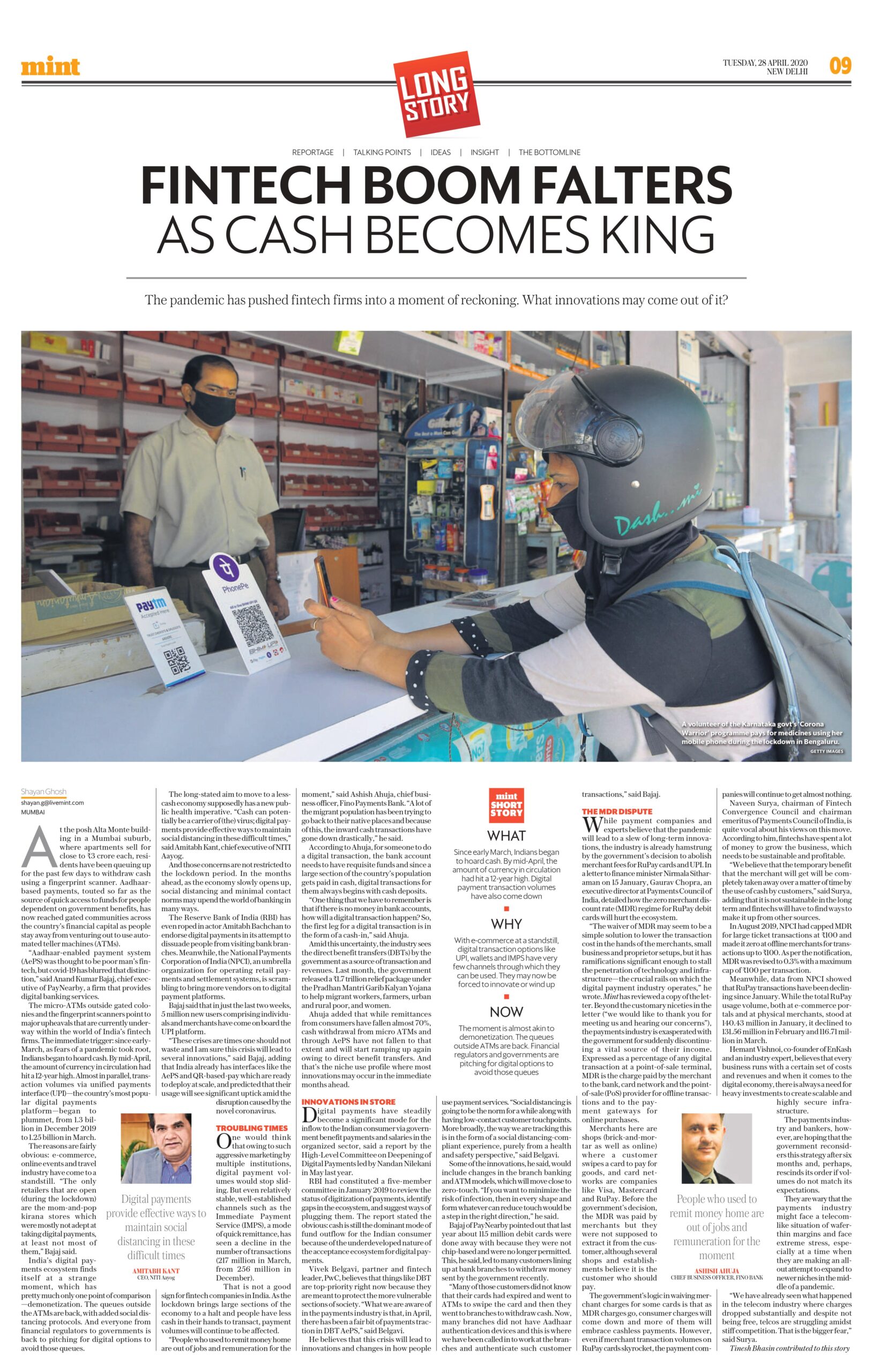
Fintech boom falters as cash becomes king

At the posh Alta Monte building in a Mumbai suburb, where apartments sell for close to 3 crore each, residents have been queuing up for the past few days to withdraw cash using a fingerprint scanner. Aadhaar-based payments, touted so far as the source of quick access to funds for people dependent on government benefits, has now reached gated communities across the country’s financial capital as people stay away from venturing out to use automated teller machines (ATMs).

“Aadhaar-enabled payment system (AePS) was thought to be poor man’s fintech, but covid-19 has blurred that distinction,” said Anand Kumar Bajaj, chief executive of PayNearby, a firm that provides digital banking services.

The micro-ATMs outside gated colonies and the fingerprint scanners point to major upheavals that are currently underway within the world of India’s fintech firms. The immediate trigger: since early-March, as fears of a pandemic took root, Indians began to hoard cash. By mid-April, the amount of currency in circulation had hit a 12-year high. Almost in parallel, transaction volumes via unified payments interface (UPI)—the country’s most popular digital payments platform—began to plummet, from 1.3 billion in December 2019 to 1.25 billion in March.

Coronavirus: Rural India to face cash shortage amidst lockdown, says BCFI

The Business Correspondent Federation of India (BCFI), a body representing fintech companies working towards the delivery of financial services to underbanked and unbanked, on Friday discussed challenges arising in the rural economy after the Indian government announced a national lockdown to curb the spread of COVID-19 in the country.

Members of the BCFI also estimate a cash shortage to arise in rural areas of the country as Business Correspondents (also called ‘Bank Mitra’) are restricted from travelling.

The industry body estimated that due to this forced shutdown, only 30 percent of their Business Correspondents are active in rural regions, putting additional operational load on the players.

Post the announcement of the lockdown on Tuesday, the Ministry of Home Affairs came out with a comprehensive list of essential services that will remain operational during the nationwide lockdown.

The addendum to these guidelines included Business Correspondents (in sub-clause B to clause 4) along with IT Vendors for banking operations and cash management agencies as essential services.

Additionally, members also said that owing to the lockdown rural banks were rationing cash  putting more pressure on the liquidity provided to the rural economy.

“There are about two lakh ATMs in the country. Of this, one lakh are on-site, which means that these ATMs are next to bank branches. Of the balance one lakh, 25,000 are ATMs in rural areas which aren’t being serviced, making operations of Business Correspondents even more critical,” explained Sunil Kulkarni, Chief Business Mentor – Oxigen Services India Private Limited and  Board Member, BCFI.

Additionally, Finance Minister Nirmala Sitharaman just yesterday announced Rs 1.7 lakh crore relief package for the economically weaker sections of the society (through Direct Benefit Transfer).

According to BCFI, the inability of BC agents to access this relief cash is a huge concern in ensuring this package reaches the beneficiaries.

The industry body has appealed to the government for financial support as these business correspondents are risking their own lives to rise to the challenge of COVID-19.

While addressing the media, through a digital mode, Anand Kumar Bajaj, MD and CEO of PayNearby and Board Member of BCFI said,

“We urge the government to provide a small remuneration of Rs 5,000 for three months to Business Correspondents to boost their morale and ensure that financial services are catered to in a seamless manner for the rural regions in the country.”

Other members addressing the media were Sasidhar Thumuluri, MD and CEO of Basix Sub-K iTransactions Limited and Chairman of BCFI; Amit Jain, Chief – Business Operations of Fino Payments Bank, and Vijay Pratap Singh Aditya, CEO of Ekgaon Technologies.

Our Partners

Download PayNearby now

Use PayNearby app & take charge of all your transactions to grow your business