Business correspondents ask banks to provide easy cash facility

The Business Correspondent Federation of India (BCFI) on Friday appealed to banks and local authorities to help its agents have safe and easy access to cash to provide essential services in semi-urban and rural areas. BCFI is a body representing fintech companies working towards the delivery of financial services to underbanked and unbanked.

The industry body said due to the 21-day nationwide lockdown on account of COVID-19, the situation is worse in rural India with limited access to primary banking services such as – cash withdrawal, money transfer.

On Thursday, Finance Minister Nirmala Sitharam announced a relief package of Rs 1.7 lakh crore for the economically weaker sections of the society.

In order to ensure that the cash reaches to the beneficiaries, BCFI has made an appeal to banks and other stakeholders in the ecosystem to help agents have safe and easy access to cash from their local banks, so that they can continue unhindered providing essential services to the common man.

“In these seriously challenging times, to ensure that that the relief package reaches the intended, and beneficiaries are able to access the cash, along with the banking systems, our business correspondents are the frontline warriors, providing access to this relief cash,” BCFI member and CEO of PayNearby Anand Kumar Bajaj said.

BCFI also requested the government for a relief package of Rs 5,000 for business correspondents for the next three months, which is less than 0.5% of the Rs 1.75 lakh crore package announced by the government.

This will motivate these correspondents to offer uninterrupted services and ensure the benefits of the relief package reach the intended and they can access the cash.

Business correspondents provide access to basic banking services such as cash deposit or cash withdrawal in remote areas. PTI HV MR MR

Challenges over cash shortage, restricted movements for government’s DBT agents

Thousands of Business Correspondents (BCs) across the country are facing shortages in cash supply and restrictions in their movements even as the responsibility to ensure the last mile transfer of government relief fund for poor affected by Covid-19 lockdown have fallen upon these banking agents.

These agents also known as Bank Mitras are last mile banking access points for millions of Jhan Dhan account holders in rural areas and are central to government’s direct benefit transfer (DBT) architecture in ensuring funds transferred to bank accounts are made available to beneficiaries in the form of cash.

However, despite being included as an essential service by the Ministry of Home Affairs, these agents are reportedly not being allowed free movement by local authorities in districts across the country, the industry representative body of these 10 lakh odd BCs – Business Correspondent Federation of India (BCFI) told journalists over a videoconference on Friday.

“Due to restrictions our BCs are not able to travel from home to banks and from banks to their banking points,” said Seema Prem, CEO,

FIA Technologoy Services and a board member of BCFI. “As a result, a sizeable number of these banking points essential for financial services are now not open.”

Furthermore, fintech companies facilitating operations between BCs and banks also said that cash shortage in banks and retail outlets is also a challenge in these times when most economic activities have come to a standstill due to the 21 day lockdown and rural citizens are depended on cash proceeds from the Rs.1.75 lakh crore worth relief package announced by Finance Minister on Thursday.

“Several branches are shut down and the movement of cash from currency chests to branches are also not happening in some places,” said Anand Kumar Bajaj, CEO, PayNearby and a board member of BCFI. “Due to the lockdown several kirana stores are also shut which generally provided cash supply for BCs.”

With dismal rural ATM penetration, the BCFI warned that several essential cash dependent supply chains such as movement of food stock from rural to urban may take a hit if the situation persisted.

Additionally, these companies also sought insurance support from government in line with those announced for medical workers for BCs operating during the lockdown to “boost morale amidst working in challenging conditions.”

Making digital payments? Know if you should you sanitize credit card, debit card, smartphones

Making digital transactions, instead of cash, is being seen as one of the many ways with which the spread of Covid-19 disease can be slowed down. According to National Payment Corporation of India (NPCI), the use of digital payments can reduce social contact and reduce the chance of transmission of novel coronavirus. Digital transactions can be made using smartphones. However, some people may have no option but to use credit card and debit card for making payments or cash withdrawals from ATMs. As we know that the novel coronavirus spreads through surfaces. Hence, is it important to sanitize debit card, credit card or smartphones as well? FE Online talked to some experts in the fintech sector on this. Here’s what they said:

“It is important to thoroughly sanitise mobile phones at regular intervals to reduce the risk of contamination since it comes in contact with our faces and hands,” said Anand Kumar Bajaj, MD & CEO, PayNearby. He also advised sanitising debit, credit and ATM cards, especially if used by someone other than the owner, since it could be swiped at crowded POS terminals or ATM machines.

From homework in childhood to work from home in adulthood

The next months will be a very strange test of our white-collar future. After the invention of the personal computer, people predicted that our jobs would eventually be emancipated from the office, and home would be the thrilling future of work. And yet, engrained work mindsets, bureaucracy, and wavering internet connections have prevented this from becoming a sweeping reality.

However, with COVID-19, all we could schedule was a screeching halt. We have rather been arm-twisted into catalyzing an anxious trial run for remote working at a grand scale— which might not be such a terrible idea for a few of us.

Nonetheless, this has taken a toll on many since change is hardly something mankind has an affinity for People are itching to get back to work; reveling in sharing their coronavirus stories over water cooler and cappuccino conversations.

Which brings us to another adage, “never let a good crisis go to waste.” This Corona wave has brought forward a much-awaited opportunity called work from home. While most of us have greeted this with a gentle smile when urgent domestic matters or work-life balance summoned it, the challenge is to turn it into the new norm—with or without a once-in-a-century public-health crisis.

So, how do we do this without losing our sanity? While in office a span of 9-10 hours made sure we took care of everything from meetings, con-calls, lunch, coffee breaks, water cooler gossips to bio-breaks, and so forth. But, in the current scenario work seems to have expanded over the time available.

Some suggestions have been echoed by all quarters:

  1. Create dedicated workspace
  2. Get dressed
  3. Stick to office timing
  4. Follow a schedule


While all these are good suggestions, and I would happily endorse them to aim at productivity levels seen during the office days. But, what about studies claiming higher productivity if we subscribed to work from home?

One of the leading reasons was employees won’t just work from 9 am to 5 pm—instead, they will cherry-pick their most-productive hours. Be it working in front of a television set, or while sipping a cup of coffee. Each one of us will discover our sweet spots when it comes to productivity. And make no mistake, they will tend to fluctuate with time, but higher productivity was promised all the way.

To delve a little further, it seems like a mix of flexibility alongside trust are the key ingredients for higher productivity. Most of us don’t indulge in an extended lunch because we are mindful of our deliverables which keeps productivity intact. Our mind is like a parachute; it works when it’s open. Hence, an open ticket to perform brings out a higher level of performance. Responsible behavior drives this performance once KPIs and performance expectations are clearly articulated and communicated. While we should not rule out governance calls completely, but at the same time, we should be wary of being overbearing. Over-governance is often interpreted as a lack of trust which drives lower productivity amongst teams. Hence, I shall make a case for letting people work at peace and to simply monitor their deliverables.

In the US, where 30% of the working population are gig workers haven’t seen any loss of productivity. In fact, they bear the same level of commitment to deliverables as full-time employees. Hence, it’s a fallacy that efficiency demands office presence. With affordable high-speed internet and video conferencing at our disposable work from home doesn’t seem far-fetched anymore. In fact, it seems to be loaded with benefits for both employers and employees. And, it’s not limited to the service sector alone, even manufacturing set-ups where certain roles are well-suited for work from home do not merit physical presence on the shop floor.

But, at the same time, we can’t turn a blind eye towards a certain set of challenges. The ones like inter-departmental work, how does one collaborate on cross-functional projects? How will the very important grapevine be kept alive? How will the instant recognition work? And, various elements of group dynamics will simply seize to exist.

And it’s for reasons like these that a complete work from home is not desirable. Instead, a rhythmic pattern of work from home will be the building blocks to mature and resilient organizations.

On the brighter side, power centres and politics will have to take a back seat. People would be more concerned with maintaining work-life balance as opposed to perceptions, and as a result, focus on performance. And the so-called bell curve will solely apply to performance outcomes as opposed to perceptions. Thereby providing a more balanced and fair assessment which will lead to better acceptance of performance ratings. Not to conclude that perception will be irrelevant, but it will certainly be far less popular.

To sum it all up, I would like to pose a few questions. Is there a silver lining to the COVID-19 crisis? Will it provide opportunities for companies to save on infrastructure costs? Can organizations work with frugal workspaces, reduced electricity bills, lower conveyance claims, and so forth? How would employees react to this new working arrangement where they must commute only for important client meetings, board meetings, review meetings? Can companies compensate for personal infrastructure built by employees for office use in the form of bonuses and increments?

Now that we have some time on us, these are a few pertinent questions worth pondering over. And if you are one of those who still don’t seem to have the time, well, these are definitely a few questions worth pondering over.


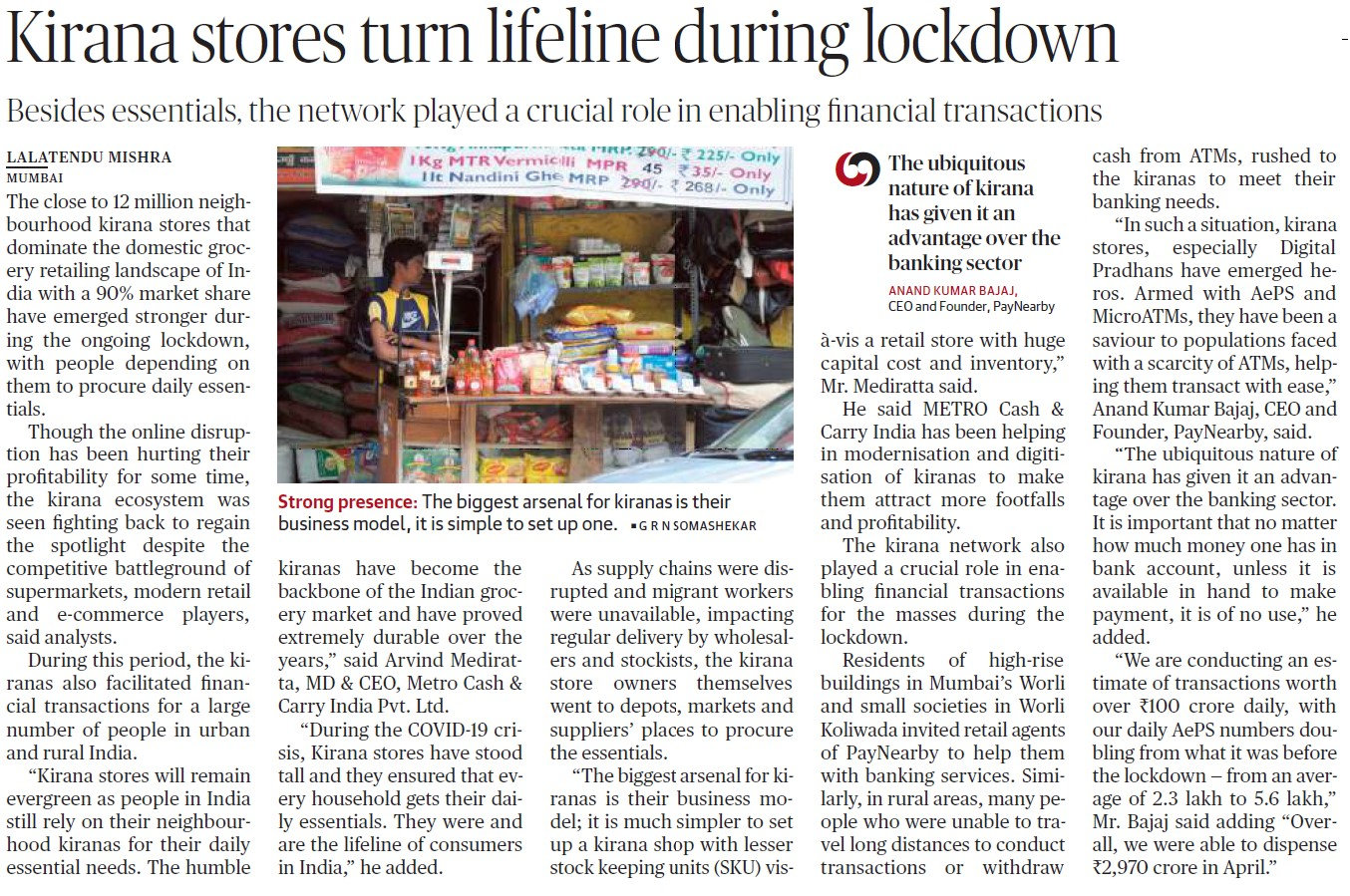
Kirana stores turn lifeline during lockdown

The close to 12 million neighbourhood kirana stores that dominate the domestic grocery retailing landscape of India with a 90% market share have emerged stronger during the ongoing lockdown, with people depending on them to procure daily essentials.

Though the online disruption has been hurting their profitability for some time, the kirana ecosystem was seen fighting back to regain the spotlight despite the competitive battleground of supermarkets, modern retail and e-commerce players, said analysts.

During this period, the kiranas also facilitated financial transactions for a large number of people in urban and rural India.

“Kirana stores will remain evergreen as people in India still rely on their neighbourhood kiranas for their daily essential needs. The humble kiranas have become the backbone of the Indian grocery market and have proved extremely durable over the years,” said Arvind Mediratta, MD & CEO, Metro Cash & Carry India Pvt. Ltd.

“During the COVID-19 crisis, Kirana stores have stood tall and they ensured that every household gets their daily essentials. They were and are the lifeline of consumers in India,” he added.

As supply chains were disrupted and migrant workers were unavailable, impacting regular delivery by wholesalers and stockists, the kirana store owners themselves went to depots, markets and suppliers’ places to procure the essentials.

“The biggest arsenal for kiranas is their business model; it is much simpler to set up a kirana shop with lesser stock keeping units (SKU) vis-à-vis a retail store with huge capital cost and inventory,” Mr. Mediratta said.

He said METRO Cash & Carry India has been helping in modernisation and digitisation of kiranas to make them attract more footfalls and profitability.

The kirana network also played a crucial role in enabling financial transactions for the masses during the lockdown.

Residents of high-rise buildings in Mumbai’s Worli and small societies in Worli Koliwada invited retail agents of PayNearby to help them with banking services. Similarly, in rural areas, many people who were unable to travel long distances to conduct transactions or withdraw cash from ATMs, rushed to the kiranas to meet their banking needs.

“In such a situation, kirana stores, especially Digital Pradhans have emerged heros. Armed with AePS and MicroATMs, they have been a saviour to populations faced with a scarcity of ATMs, helping them transact with ease,” Anand Kumar Bajaj, CEO and Founder, PayNearby, said.

“The ubiquitous nature of kirana has given it an advantage over the banking sector. It is important that no matter how much money one has in bank account, unless it is available in hand to make payment, it is of no use,” he added.

“We are conducting an estimate of transactions worth over ₹100 crore daily, with our daily AePS numbers doubling from what it was before the lockdown — from an average of 2.3 lakh to 5.6 lakh,” Mr. Bajaj said adding “Overall, we were able to dispense ₹2,970 crore in April.”

ETBFSI Virtual Summit: Stability before scale is the mantra of India’s FinTech firms

The Banking and Finance Industry has been supporting the economy whereas the Fintech space is supporting BFSI in scaling up its functions. In these hard times when people are laden with fear of physical contact, we discuss with some of the fintechs in our session with their view of how fintechs are enabling the BFSI sector and how the scenario has changed while working from home.

Anand Kumar Bajaj, Co-founder & CEO of PayNearby, describes how “Collaboration and productivity are at their highest peak and yet there are challenges”. Following the strategy of “Stability before Scale” he told that even after planning for 2x, 3x volume, they had faced a system crash when Coronavirus had caused a surge in their volumes to a level of 4x or even 5x.

In these testing times, the entire force of 8 Lakh employees of PayNearby is helping the entire DBT payment system by working hand in hand with the government.

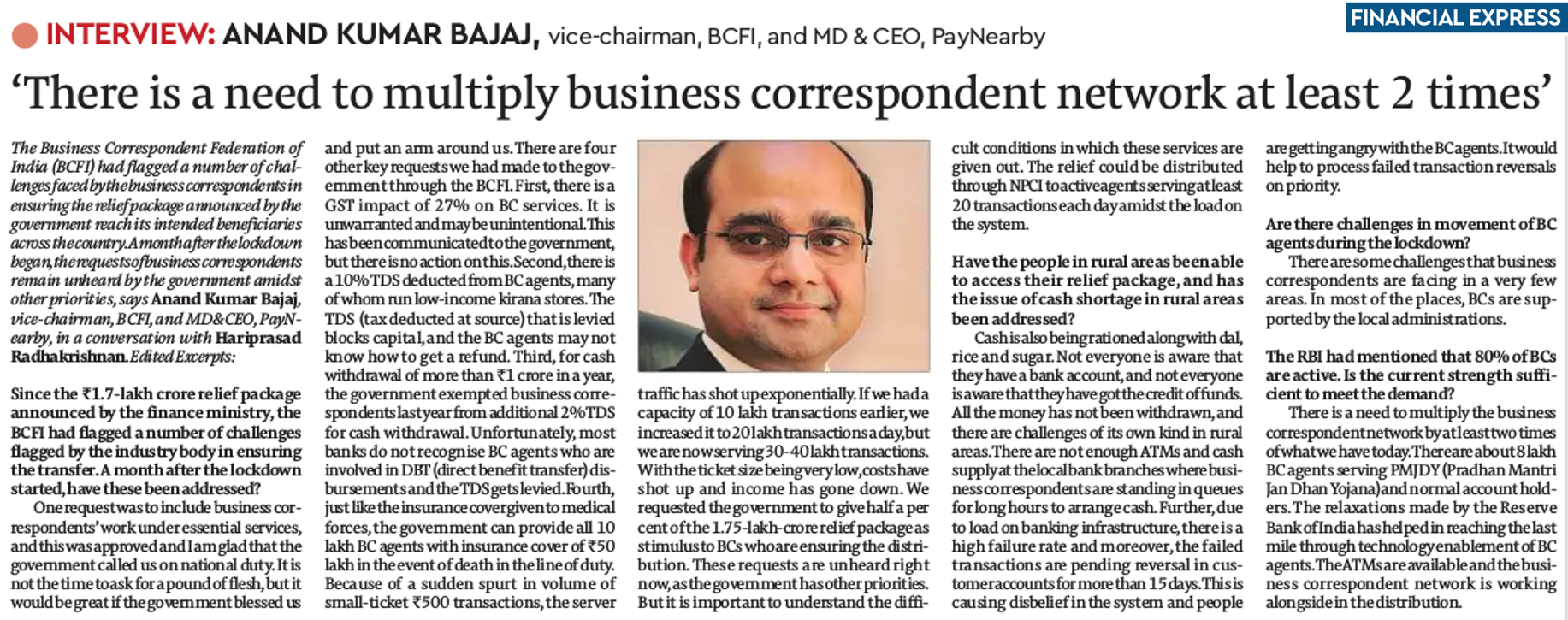
There is a need to multiply business correspondent network at least 2 times

For cash withdrawal of more than Rs 1 crore in a year, the government exempted business correspondents last year from additional 2% TDS for cash withdrawal. Unfortunately, most banks do not recognise BC agents who are involved in DBT (direct benefit transfer) disbursements and the TDS gets levied.

The Business Correspondent Federation of India (BCFI) had flagged a number of challenges faced by the business correspondents in ensuring the relief package announced by the government reach its intended beneficiaries across the country. A month after the lockdown began, the requests of business correspondents remain unheard by the government amidst other priorities, says Anand Kumar Bajaj, vice-chairman, BCFI, and MD & CEO, PayNearby, in a conversation with Hariprasad Radhakrishnan

Since the Rs 1.7-lakh crore relief package announced by the finance ministry, the BCFI had flagged a number of challenges flagged by the industry body in ensuring the transfer. A month after the lockdown started, have these been addressed?

One request was to include business correspondents’ work under essential services, and this was approved and I am glad that the government called us on national duty. It is not the time to ask for a pound of flesh, but it would be great if the government blessed us and put an arm around us. There are four other key requests we had made to the government through the BCFI. First, there is a GST impact of 27% on BC services. It is unwarranted and may be unintentional. This has been communicated to the government, but there is no action on this.

Second, there is a 10% TDS deducted from BC agents, many of whom run low-income kirana stores. The TDS (tax deducted at source) that is levied blocks capital, and the BC agents may not know how to get a refund. Third, for cash withdrawal of more than Rs 1 crore in a year, the government exempted business correspondents last year from additional 2% TDS for cash withdrawal. Unfortunately, most banks do not recognise BC agents who are involved in DBT (direct benefit transfer) disbursements and the TDS gets levied.

Fourth, just like the insurance cover given to medical forces, the government can provide all 10 lakh BC agents with insurance cover of Rs 50 lakh in the event of death in the line of duty. Because of a sudden spurt in volume of small-ticket Rs 500 transactions, the server traffic has shot up exponentially.

If we had a capacity of 10 lakh transactions earlier, we increased it to 20 lakh transactions a day, but we are now serving 30-40 lakh transactions. With the ticket size being very low, costs have shot up and income has gone down. We requested the government to give half a per cent of the 1.75-lakh-crore relief package as stimulus to BCs who are ensuring the distribution. These requests are unheard right now, as the government has other priorities. But it is important to understand the difficult conditions in which these services are given out. The relief could be distributed through NPCI to active agents serving at least 20 transactions each day amidst the load on the system.

Have the people in rural areas been able to access their relief package, and has the issue of cash shortage in rural areas been addressed?

Cash is also being rationed along with dal, rice and sugar. Not everyone is aware that they have a bank account, and not everyone is aware that they have got the credit of funds. All the money has not been withdrawn, and there are challenges of its own kind in rural areas. There are not enough ATMs and cash supply at the local bank branches where business correspondents are standing in queues for long hours to arrange cash. Further, due to load on banking infrastructure, there is a high failure rate and moreover, the failed transactions are pending reversal in customer accounts for more than 15 days. This is causing disbelief in the system and people are getting angry with the BC agents. It would help to process failed transaction reversals on priority.

Are there challenges in movement of BC agents during the lockdown?

There are some challenges that business correspondents are facing in a very few areas. In most of the places, BCs are supported by the local administrations.

The RBI had mentioned that 80% of BCs are active. Is the current strength sufficient to meet the demand?

There is a need to multiply the business correspondent network by at least two times of what we have today. There are about 8 lakh BC agents serving PMJDY (Pradhan Mantri Jan Dhan Yojana) and normal account holders. The relaxations made by the Reserve Bank of India has helped in reaching the last mile through technology enablement of BC agents. The ATMs are available and the business correspondent network is working alongside in the distribution.

More options of contactless payments needs to be offered

Anand Kumar Bajaj, CEO & Founder, PayNearby

While contactless payments need to be embraced fervently in this challenging period, some geographies and customer segments will have to be assisted to be moved into the digital mode. It is especially important during these testing times that citizens across all segments of the society have the resources to take care of their needs. In places where physical money exchange is unavoidable, players need to build awareness around the situation and on a war footing cultivate best practices while cash is getting exchanged.

At PayNearby to curb the spread of the epidemic and raise awareness, we are focusing all our energies to run campaigns that train people to sanitize their hands before and after exchanging cash. The campaign is called “Zidd aapke Suraksha ki; Zidd Surakshit aage badhne ki” where customers and retailers are made aware of the need to wash their hands with soap and water or a hand santitizer, after conducting any financial transaction. This has been communicated to over 10 lakh retailers across 17,000 plus PIN codes. Our teams are putting all their energies to ensure every retailer is made aware of it, and puts this into practice. We are happy to share that more than 250 videos replaying this core messaging have already been made and shared by our retailers in various social forums, and it gives us great comfort to see this level of awareness and proactive social messaging.

Contactless payments is the way to tide over the current tough times!

Digging the new oil well – ‘Data’

Knowledge is power in business, and data is the fuel that creates this power. Being able to harness the power of data through data science is extremely valuable, and often is the biggest differentiator between success and failure.

Due to insights that data science can offer, more and more businesses are utilizing the same to make evidence-based decisions to maximize their customer interactions, tailor micro-communications and explore the full potential of available resources. However, the vast amount of data available can be overwhelming, and if not interpreted and simplified, is rendered useless. This can be problematic at times, since roughly 80% of all data is unstructured, and needs the right tools and expertise to make it consumable.

Data-first methodology aids agile business strategies besides helping companies with enhanced business decisions. Hence it’s important that companies “test-measure-implement” anything and everything—which means that this data first culture should strongly be embedded in our DNA. Companies can have in-house scientists that help them in optimizing decision making, KPI tracking, marketing, and sales. Data security should be the main priority since it will not only help you to secure data but stack the same in a highly regulated setup that extracts, transforms and loads data seamlessly every single day.

There are several mechanisms in place to improve our product and business metrics to provide high-quality consumer service. Through PowerBI, which is used for dashboarding visualization and reporting, one can track product performance and business health. This enables the senior management and CXOs to be aware of all the key metrics and also gives them a UI through which, based on the filters, they can extract metadata.

Machine learning is a crucial aspect to utilize current market trends for product optimization and devising innovative marketing strategies. It is a robust system to help achieve one’s business goals at a faster rate. A Product Cross-Sell system bases on product usage, location, and line of business can help you identify gaps in consumer needs. PAN Card and OCR system use an extensive layer of Google Vision and machine learning, which allows one to interpret data directly from an image, thereby reducing human errors. It further corroborates the motto to “Automate or Eliminate”.

Another aspect where machine learning is extremely useful is price optimization. As a business, it is critical to build effective pricing automation solutions to achieve sales targets. Factors such as competition, market positioning, production costs, and distribution costs play a key role for retailers in order to create a significant business impact. ML can be of great help in this case and have an enormous impact on KPIs. Its power lies in the fact that the developed algorithms can learn patterns from data, instead of being explicitly programmed. ML models can continuously integrate new information and detect emerging trends or a new demand, and help identify how consumers react to different pricing or how that price impacts business goals. Additionally, Market Estimation using the stacked ML model helps us understand new areas where markets can be created and how sales strategies should be developed to maximize market share.

The use of data science in business is a constantly evolving spectrum, and trends will keep cropping for businesses to leverage. Reaching the right target audience, providing the metrics to measure the impact of marketing campaigns and allowing businesses to emulate the impact of any business decision on growth before actually implementing the strategies are key ways that cement the fact that data science is the future of decision making.

Our Partners

Download PayNearby now

Use PayNearby app & take charge of all your transactions to grow your business